
Economy & Global Constants
Landing fee at a major hub? Loan interest rates? When does my company auto-pause? How much is a Business class seat worth? A single reference chapter for every recurring number not covered in previous chapters.
TL;DR — the key points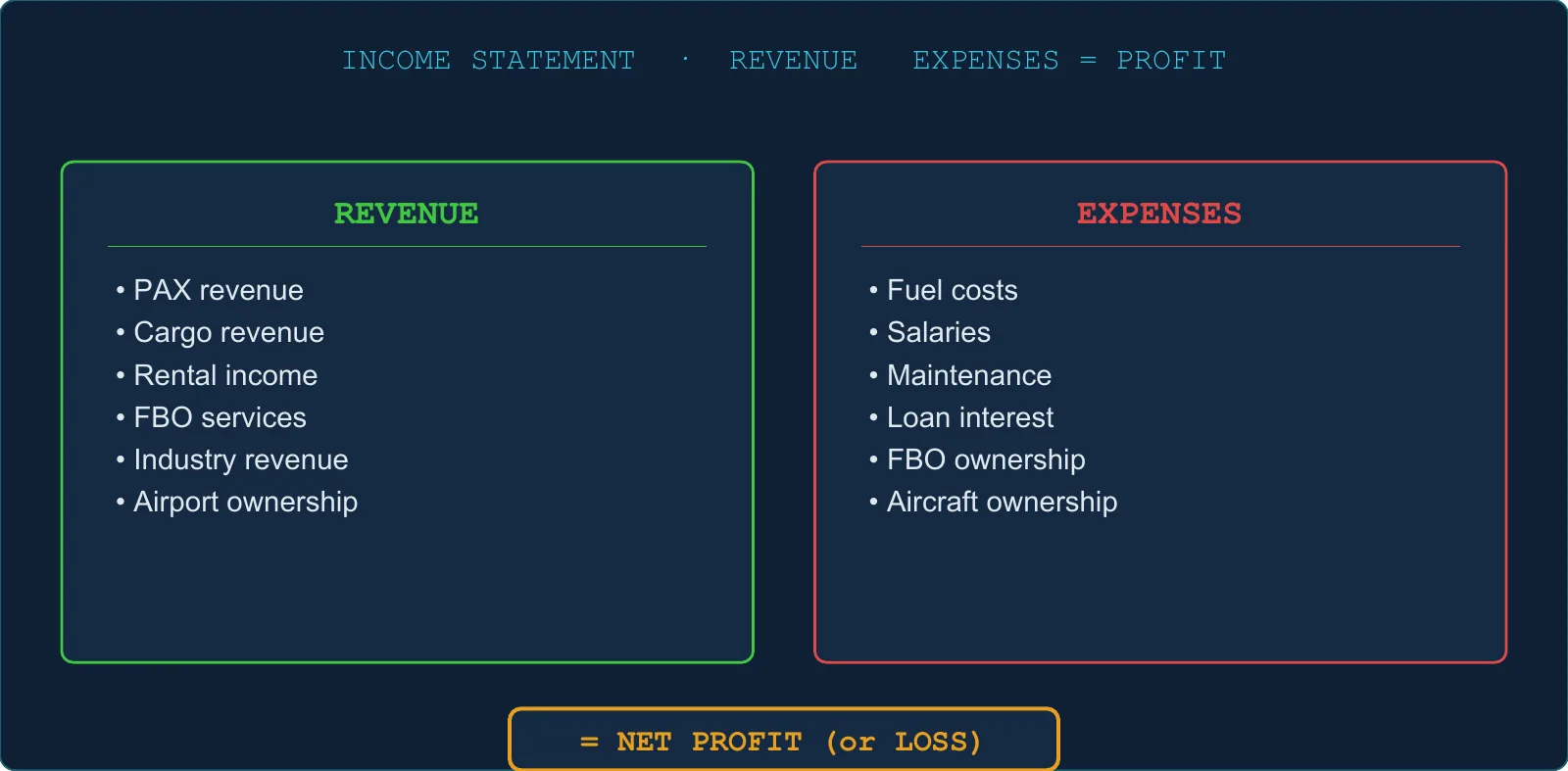
8.1 Landing & parking fees
Landing fee
7 Cr × aircraft MTOW ÷ 1 000 lbs
- Flat constant — no airport-size modifier, no time-of-day, no season.
- Charged when a flight is registered.
- Airport owners can set a lower custom rate — never higher than the default.
- No takeoff fee, no ATC fee, no handling fee.
Example: a 500 000 lbs widebody landing anywhere = 3 500 Cr landing fee.
Parking fee (hourly)
Same formula as the FBO & Hangar chapter — reproduced here for convenience:
| Airport Size | Fixed / h | Per 1 000 lbs above 200 k lbs / h |
|---|---|---|
| 0 | 4.375 Cr | 0.0625 Cr |
| 1 | 5.250 Cr | 0.0750 Cr |
| 2 | 6.125 Cr | 0.0875 Cr |
| 3 | 7.000 Cr | 0.1000 Cr |
| 4 | 7.875 Cr | 0.1125 Cr |
| 5 | 8.750 Cr | 0.1250 Cr |
Your own FBO covers aircraft within its combined hangar/tie-down capacity, most expensive first. Overflow is chargeable. Basecamps and paused companies are exempt; skills and custom airport-owner tariffs can reduce the charge (§2.7).
8.2 Bank loans
Access requirement: Bank Loans Agreement. Loan Interest Reduction improves the rate but is not needed to unlock borrowing.
How much you can borrow
Available capacity = (min(10 000 000 Cr, share capital × 3 + company value) − outstanding principals) × (1 + reputation) × difficulty factorReputation is a fraction (50% = 0.5). The 10 M ceiling applies before the reputation and difficulty multipliers, so it is not a final loan cap. Existing unpaid principal reduces capacity first.
Difficulty modifier on capacity:
| Difficulty | Capacity multiplier |
|---|---|
| Easy | ×1.5 |
| Classic | ×1.0 |
| Realistic | ×0.7 |
Annual interest rate
| Company capacity bracket | Annual rate |
|---|---|
| Above 20 M Cr | 6 % |
| Above 10 M Cr | 7 % |
| Above 3 M Cr | 8 % |
| Above 1 M Cr | 10 % |
| 1 M Cr or below | 12 % |
Your interest rate is then adjusted:
- Divided by
(1 + reputation ÷ 10)→ higher reputation, lower rate. - Reduced by
Loan Interest Reduction level × 1 %. - Read the quoted rate: the current calculation only substitutes 5% if the adjusted rate is negative. A non-negative rate below 5% is retained; there is no general 5% floor.
Loan terms offered
- Durations: 48 / 96 / 144 / 192 weeks (12 / 24 / 36 / 48 periods of four weeks).
- Rate multipliers by duration: ×1.0 / ×1.5 / ×1.9 / ×2.0.
- Up to 17 proposals across six amount fractions and selected durations; non-positive amounts are filtered out. Read the actual list rather than assuming a complete rectangular set of offers.
Repayment
- Deducted automatically every 7 days during the daily finance check at 04:45 UTC.
- Early repayment penalty: 10 % of the remaining principal.
8.3 Weekly management fee — Challenge Mode only
This fee (charged every Wednesday at 06:00 UTC) applies only to companies in Challenge Mode. Standard career companies never pay this fee.
Fleet portion (if you own or rent more than 5 aircraft)
The fee increases with fleet size, up to a cap:
| Fleet size | Fee rate per aircraft |
|---|---|
| 6 aircraft | ~0.02 % of base price |
| 20 aircraft | ~0.29 % of base price |
| 35+ aircraft | ~0.585 % of base price (cap) |
FBO portion (if you own more than 3 FBOs)
A surcharge is added on top of your regular FBO weekly fees based on how many FBOs you own beyond 3.
8.4 Company auto-pause
Trigger: no login for 7 consecutive days.
VAs are excluded. Already-paused or deleted companies are excluded.
What changes when paused
| System | Behaviour when paused |
|---|---|
| Loan deductions | Skipped |
| Salaries | Skipped |
| Management fee (Challenge Mode) | Skipped |
| Your FBO visibility to others | Hidden |
How to unpause
The server resumes an eligible company when you return to it; there is no need to wait for the next daily cycle. Freelance mode has separate rules and does not itself resume Advanced company management. Individual scheduled activities still follow their next processing pass.
8.5 Employee salaries
Paid every day at 05:00 UTC. A salary fires when 7 or more days have passed since the last payment.
Eligible employees: non-player characters, not on a freelance contract, and from a company that has been active in the past 15 days.
Pay formula
Regular employees:
salary = max(weekly guaranteed salary × days_elapsed ÷ 7, hourly rate × hours_flown)The guaranteed minimum is prorated if fewer than 7 days have elapsed.
Freelance employees:
salary = max(3 hours of wages, hours_flown × hourly rate)Guaranteed minimum = 3 hours of wages per payment (not a weekly prorated amount).
8.6 Account codes — your financial statements
Understanding these codes helps you read your company's income statement and balance sheet.
Revenue
| Account | What it tracks |
|---|---|
| PAX revenue | Passenger transport earnings |
| Cargo revenue | Cargo transport earnings |
| Rental income | Renting your aircraft to others |
| FBO services | Workshop markup earned from other players |
| FBO fuel sales | Fuel resold at your FBO |
| Scenario revenue | Campaign/story mission rewards |
| VA revenue | Virtual Airline related income |
| Financial adjustments | Refunds and asset adjustments |
| Industry revenue | Factory production sales |
| Airport ownership | Landing/parking fee income as airport owner |
Expenses
| Account | What it tracks |
|---|---|
| Fuel costs | Fuel burned on your flights |
| Staff salaries | Regular employee wages |
| Freelance salaries | Freelance employee wages |
| Outsourcing | Costs of outsourced jobs |
| Landing & parking | Fees you pay at other airports |
| Maintenance | Aircraft maintenance and inspections |
| Rental costs | Cost of renting aircraft from the market |
| Financial costs | Loan interest + weekly management fees |
| Training | Employee training expenses |
| FBO ownership | Weekly FBO ownership fees |
| Penalties | Mission penalty charges |
| Cargo storage | Hangar storage fees |
| Aircraft ownership | Weekly aircraft ownership fees |
| Industry expenses | Factory operating costs |
FBO fuel stock is an asset, not an operating expense. When you buy fuel for your FBO tank, that money becomes the value of your fuel inventory. It is shown on the balance sheet under assets — not as a cost in your income statement.
The three statements — what each one answers
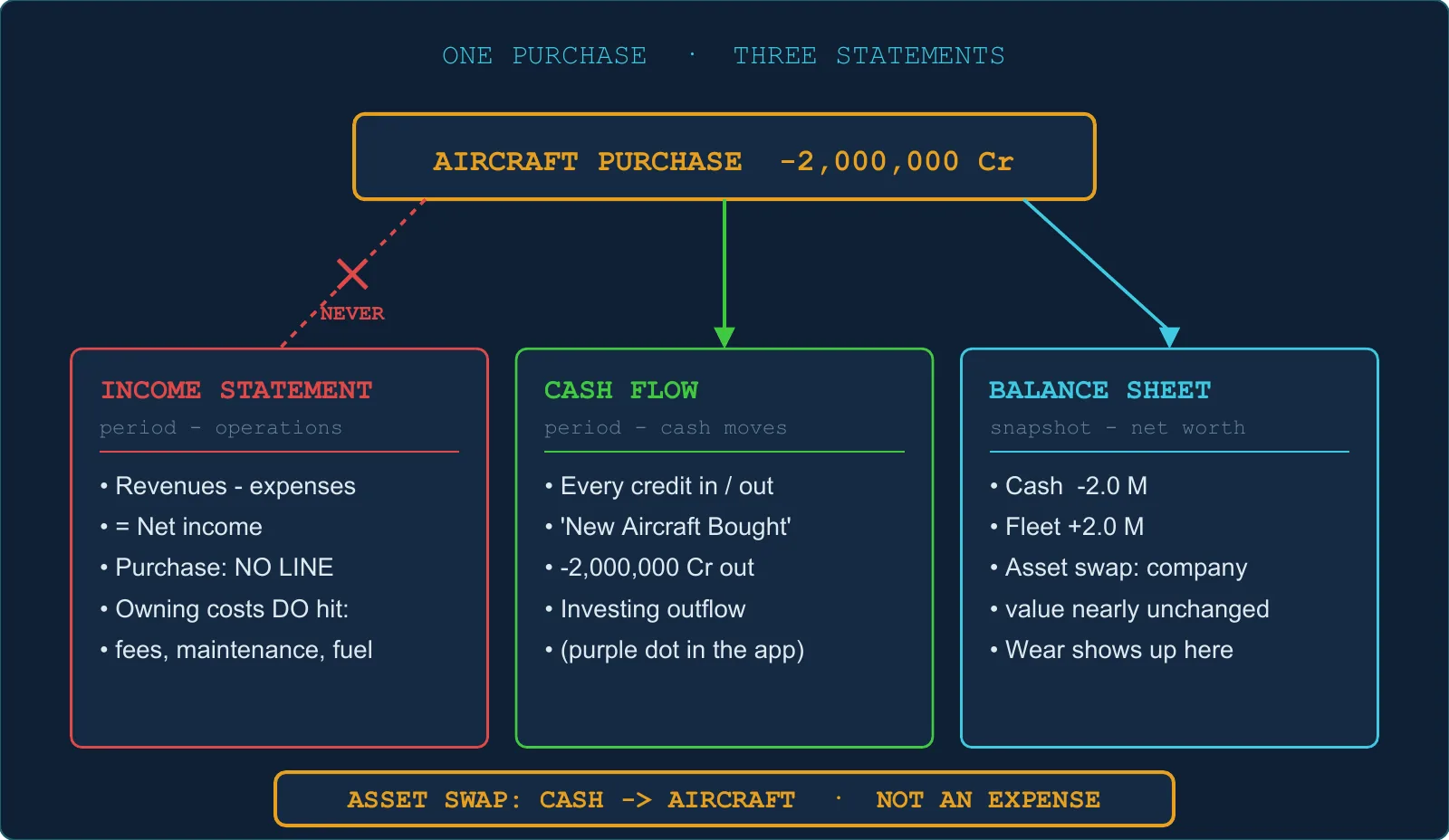
OnAir keeps a real chart of accounts with the same four categories real accountants use (Revenues, Expenses, Assets, Liabilities), and derives three complementary reports from it. Each answers a different question:
| Statement | Time basis | Question it answers | An aircraft purchase... |
|---|---|---|---|
| Balance Sheet | Snapshot (a date) | What is my company worth right now? | Shows — cash down, fleet assets up |
| Income Statement | Flow (a period) | Did my operations make a profit? | Never shows — it is not an expense |
| Cash Flow | Flow (a period) | Where did my cash physically go? | Shows — a large investing outflow |
Why buying an aircraft never appears on the Income Statement
Buying an aircraft is an asset swap: cash becomes a flyable asset you still own. Nothing was consumed, so nothing is expensed — the Income Statement keeps measuring pure operating performance (revenues earned minus costs consumed). Real-world accounting works exactly the same way: a capital purchase is capitalised on the balance sheet (IAS 16), and the cash paid out is classified as an investing activity on the cash flow statement (IAS 7). A real airline's income statement has no "bought 15 aircraft" line either.
Worked example — you earn 300 000 Cr from charters this week, spend 80 000 Cr on fuel, fees and wages, and buy a light jet for 2 000 000 Cr:
| Event | Income Statement | Cash Flow | Balance Sheet |
|---|---|---|---|
| Charter revenue | +300 000 | +300 000 in | Cash +300 000 |
| Fuel, fees, wages | −80 000 | −80 000 out | Cash −80 000 |
| Aircraft purchase | — | −2 000 000 out | Cash −2 000 000 · Fleet +≈2 000 000 |
| Bottom line | Net income +220 000 | Net cash −1 780 000 | Company value ≈ +220 000 |
You were profitable that week even though your cash collapsed — profitability and cash position are different questions, which is exactly why separate statements exist. What does hit the Income Statement is the cost of owning and operating the aircraft: weekly ownership fees, maintenance, fuel, crew, landing fees. The wear itself reaches your books through the Balance Sheet, whose fleet line tracks each airframe's market value (§9.3) — OnAir's equivalent of depreciation.
Paid above book value? A brand-new aircraft costs 1.2 × base price but enters your assets at market value — Company Value dips by the premium at purchase, like a new car losing value as it leaves the dealership.
Official references:
- SEC — Beginners' Guide to Financial Statements —
sec.gov/about/reports-publications/beginners-guide-financial-statements - IAS 1 (Presentation of Financial Statements), IAS 7 (Statement of Cash Flows), IAS 16 (Property, Plant and Equipment) —
ifrs.org/issued-standards/list-of-standards/
8.7 Company level
- XP to level up:
level × 1 000(linear — not exponential). - On level up: +2 skill points granted.
Level-gated features
| Feature | Formula |
|---|---|
| Max simultaneous missions | 100 + level × 5 |
| Max pilots (standard company) | 2 + 2 × level × reputation |
| Max pilots (VA) | 20 + 5 × level × reputation |
| Max airport ownerships | 3 + level |
| Max AI routes | 20 + level |
| Max basecamps | level × 2 |
| Max factories | Base count + level |
8.8 Passenger class economics
| Class | Factor (under 130 seats) | Factor (130+ seats) |
|---|---|---|
| Economy | 1.0 | 1.0 |
| Business | 1.3 | 2.0 |
| First | 1.5 | 3.0 |
Standard passenger weight: 190 lbs. Seat weight: 63 lbs.
8.9 Rescue mission ranges
| Detail | Value |
|---|---|
| Maximum search range | 100 NM |
| Range tiers available | 5 / 10 / 25 / 100 NM |
| Locations per tier | 10 |
8.10 Starting bonus — Advanced Management unlock
When you upgrade from Freelance (Onboarding) mode to Advanced Career:
| Difficulty | World type | Starting bonus |
|---|---|---|
| Easy | Any | 470 000 Cr |
| Classic | Any | 170 000 Cr |
| Realistic | Survival world | 10 000 Cr |
| Realistic | Standard world | 70 000 Cr |
Your existing freelance cash is also doubled at unlock.
There is no creation fee when starting a company from scratch.
What the difficulty level sets. On Cumulus you choose Easy, Classic or Realistic when you create a company. Stratus and Thunder companies are created as Realistic, with no choice. It sets the starting equity above, the starting reputation (70 % / 50 % / 30 %, which then evolves with your flights) and a loan capacity multiplier (×1.5 / ×1.0 / ×0.7) that stays for the life of the company. A lower reputation also lowers the hourly rate used for freelance job pay (700 + 500 × reputation, in Cr per hour), and a lower capacity or reputation can raise loan interest rates.
It does not decide whether you can use AI pilots: AI flights depend on the world, and Thunder forbids them. It is also separate from the Challenge Mode economy, which the world sets when the company is created and which can be changed afterwards.
8.11 Aircraft wear constants
| Constant | Value |
|---|---|
| Condition loss per 100 flight hours | −12 % |
No idle condition decay. Your aircraft's condition only drops from flight hours and specific events — not from sitting on the ramp.
8.12 Flight duty caps
| Limit | Value |
|---|---|
| Maximum flight duty period | 14 hours |
| Maximum single flight duration | 14 hours |
| Mandatory rest after a duty period | 8 hours |
| Relocation (Change base) | instant — and it moves the home airport only, not the employee |
8.13 Leasing vs. owning
| Detail | Value |
|---|---|
| Weekly leasing cost | Base weekly ownership fee × 1.2, then the selected term adjustment; three weeks paid upfront |
| Owned aircraft efficiency advantage | 2 % cheaper per hour vs. rented |
Accounting view: lease and rental payments are operating expenses — they hit your Income Statement every week. A purchase is an investment and never does (see §8.6).
8.14 Industry fuel supply
| Detail | Value |
|---|---|
| Fuel per factory shipment | 5 500 gallons |
| FBO Refueling: free transport range | 250 NM from the FBO |
| FBO Refueling: factory owner's transport cost | 10 Cr per tank per NM beyond 250 NM |
| Auto-sell to system discount | −40 % (you receive 60 % of base price) |
| System supply suppression range | 200 NM around a player factory |
Local Dealer is separate from FBO Refueling: eligible player factories within 250 NM sell whole fuel tanks to the server, nearest first, at the local dealer price when an FBO orders fuel or system restocking runs. There is no Local Dealer purchase outside that radius and no change to the FBO customer's order price. See §3.10.
8.15 Airport ownership
| Detail | Value |
|---|---|
| Maximum airport Size that can be owned | 5 |
| Maximum missed weekly payments | 1 |
| Advance payment required | 2 weeks upfront |
| Free kits at acquisition | 10 |
| Maximum ownerships per company | 3 + company level |
Weekly kit cost by airport Size
| Size | Kits needed per week |
|---|---|
| 0 | 1 |
| 1 | 2 |
| 2 | 3 |
| 3 | 5 |
| 4 | 25 |
| 5 | 50 |
| Basecamp | 0 (free) |
Revenue per flight as airport owner
| Size | Per human flight | Per AI flight |
|---|---|---|
| 0 | 1 000 Cr | 50 Cr |
| 1 | 1 200 Cr | 60 Cr |
| 2 | 1 400 Cr | 70 Cr |
| 3 | 1 600 Cr | 80 Cr |
| 4 | 1 800 Cr | 90 Cr |
| 5 | 2 000 Cr | 100 Cr |
- Human-only world: human-flight payout is doubled.
- AI flights earn 1/20th of the human rate.
The kits must be sitting at that airport on the due date. Kits held in another warehouse, or still flying toward the field, do not count — the payment simply fails as if you had none. Plan the delivery, not just the production.
Falling behind. One missed week is tolerated: the airport is flagged
At risk and the arrears roll into the next bill. Miss a second time and the airport is taken back. Flying the kits in before that second deadline costs you nothing but the trip.
What the traffic actually pays. Only flights pay the subsidy. The passengers and cargo that transited are counted and displayed, but they are worth nothing — they are there to tell you how busy the field is, not to earn. Every counter resets at each payout.
8.16 Airport boosts
Owning an airport unlocks a Boosts tab on it. A boost is a renewable benefit attached to that field, and it applies to everyone's activity there — including yours. There are six, each with three levels:
| Boost | What it multiplies | Level 1 | Level 2 | Level 3 |
|---|---|---|---|---|
| Company Jobs | pay on generated FBO jobs; depends on airport Size | +2 to +10 % | +3 to +20 % | +4 to +30 % |
| XP Boost | XP earned on flights there | +10 % | +20 % | +30 % |
| Company Routes | Regular Route pay | +10 % | +20 % | +30 % |
| Freelance Boost | freelance route pay | +50 % | +100 % | +150 % |
| Industry Boost | points added to positive global machine efficiency | +10 pts | +20 pts | +30 pts |
| FBO Workshop | quoted maintenance work-time reduction (§4.4) | −10 % | −20 % | −30 % |
What a boost costs
The price is not in credits. A boost costs its own level in Airport Ownership Kits, every week — level 1 costs 1 kit a week, level 2 costs 2, level 3 costs 3. All six types cost the same; only the level moves the number.
The same rule as the rent applies, and it is the one that catches people:
The kits must be sitting at that airport. Kits in another warehouse, or in transit, do not count. The first week is debited the moment you buy, and again every seven days for as long as auto-renew is on.
And the constraint that decides whether any of this is reachable at all:
Kits are not sold by the system. No amount of money buys one. They come from another player on the Trading Hall, or from your own Airport Ownership Kit Facility (§10.4). A boost you cannot feed simply lapses.
Reading the value
Three of the six pay you back in credits (Company Jobs, Company Routes, Freelance), one pays in progression (XP), one in goods (Industry) and one in time (FBO Workshop). The Freelance credit boost reaches +150% at level 3. Company Jobs instead uses the airport-Size table in §7.3.6. Industry adds efficiency points before the production-time formula; it does not promise the same percentage of extra goods, and does not shorten an already minimum-length cycle.
Remember the boost helps every pilot who flies there, not only you. On a field other companies use, you are subsidising their queries and their XP as well as your own.
8.17 Internal balance constants (for reference)
| Constant | Value | Purpose |
|---|---|---|
| Standard pilot cost | 80 Cr/h | Economy baseline |
| Repositioning pilot (no crew) | 120 Cr/h | Rental return without assigned crew |
| Weekly ownership amortisation | 24 weekly payments | How long a new aircraft is expected to pay itself off |
| Rental return missing-fuel penalty | ×2.0 on missing gallons' value | |
| Lease return condition shortfall penalty | ×1.25 on repair cost delta |
8.18 TL;DR
- Landing fee: MTOW × 0.007 Cr/lb. No airport-size variation.
- Loans: Bank Loans Agreement unlocks access; read the adjusted quote, which can be below 5%. Early repayment adds 10% to remaining principal.
- Weekly management fee: Challenge Mode only — standard companies never pay it.
- Auto-pause: after 7 days of inactivity. Unpause by simply logging in.
- Salaries: paid every 7 days at 05:00 UTC; higher of guaranteed minimum or hours × rate.
- Airport ownership scales steeply with size — Size 5 costs 50 kits/week but earns 2 000 Cr per human flight.
- Starting bonus at Advanced Management unlock: 470 k Cr (Easy) → 10 k Cr (Realistic, survival world).
- Aircraft purchases never hit the Income Statement — they are asset swaps (cash → fleet), visible on the Cash Flow and Balance Sheet only (§8.6).