
Freelance & Missions
Why does a 20-minute hop pay more per NM than a long-haul? What's the real formula behind freelance charter fares? Which multipliers stack? Everything about missions, freelance, regular routes, and the money they produce.
TL;DR — the key points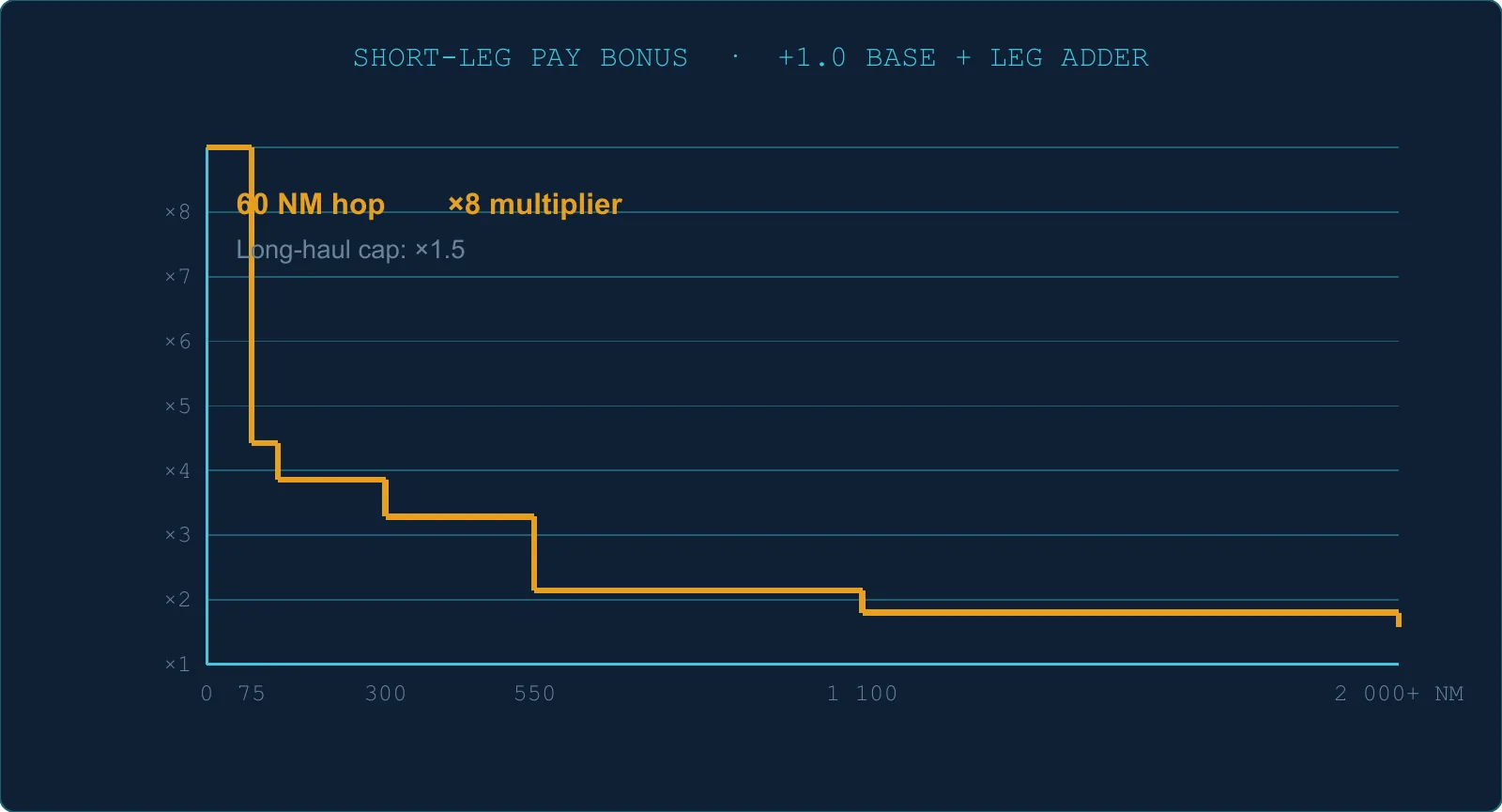
7.1 The 21 mission types
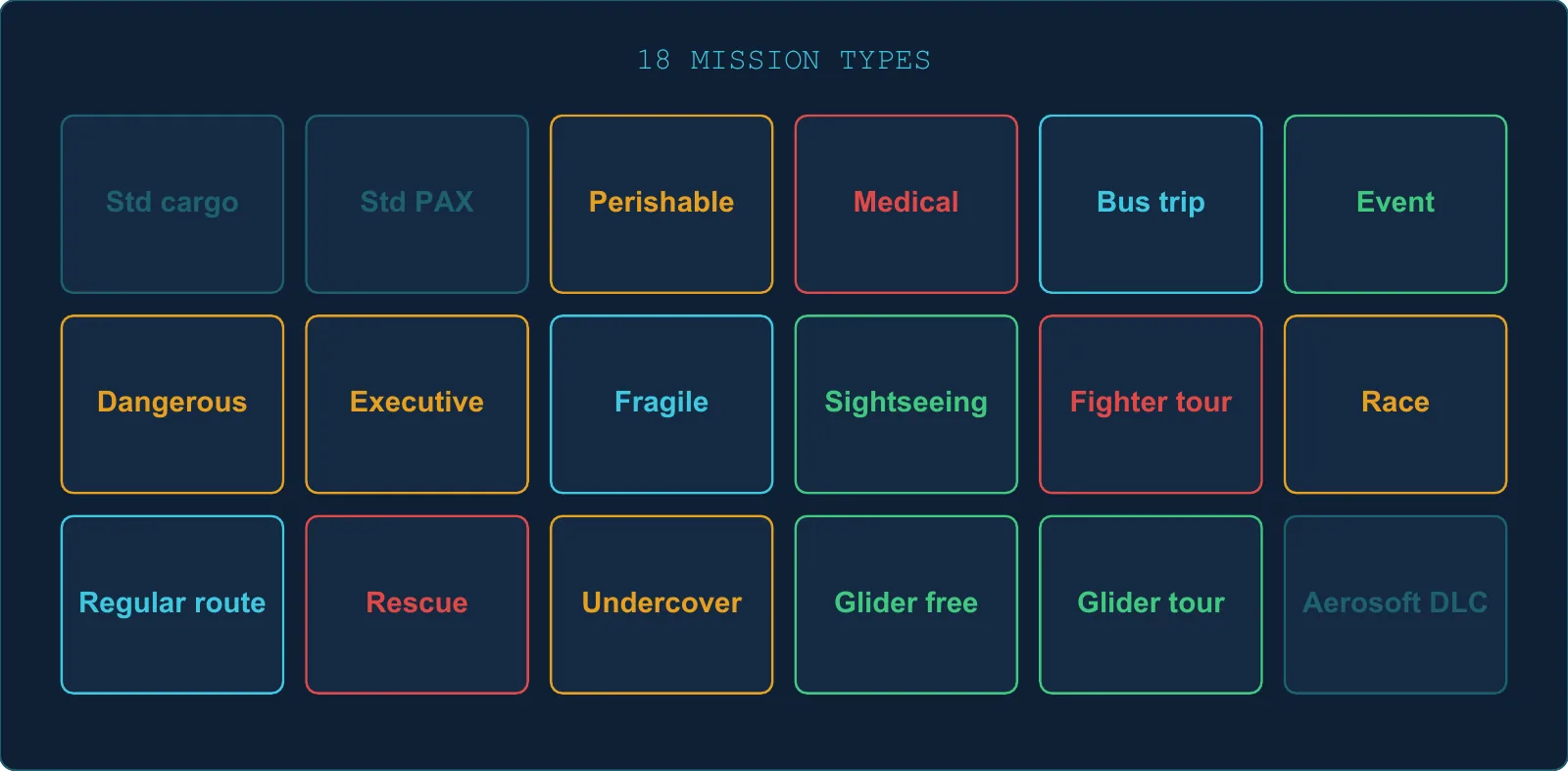
Missions have two classifications — a type (what kind of job it is) and a category (where it comes from).
Mission types
| Mission type | Notes |
|---|---|
| Standard cargo / PAX | The default — covers most job board missions |
| Perishable | Time-constrained cargo with expiry bonus |
| Medical | Requires the Medical Transport skill |
| Bus trip | Passenger bus route |
| Event | Special event missions |
| Dangerous goods | Requires the Dangerous Goods skill |
| Executive PAX | High-value passengers |
| Fragile cargo | Carries a maximum G-force constraint |
| Sightseeing | POI-based tour |
| Fighter tour | Round-trip tour for fighter aircraft |
| Race | Racing mission |
| Regular route | Weekly scheduled route (see §7.6) |
| Rescue | Search-and-rescue with uncertain location |
| Undercover | Hidden destination missions |
| Glider free flight | Glider missions |
| Glider sightseeing | Glider POI tour |
| Aerosoft DLC missions | Special DLC content |
Mission categories
| Category | Where it comes from |
|---|---|
| Grind | Job board, logistic center, regular routes |
| Main quest | Story missions |
| Side quest | Side story missions |
| Event | World event |
| Freelance | Freelance charters (5-job cap) |
| Work group relief | Ground operations relief |
7.2 Two completely different pay engines
OnAir uses two separate pay logics depending on whether the job is freelance or grind. Understanding the difference is essential.
Engine A — Grind (job board, logistic center, regular routes)
Grind pay is freight-style: you are paid for what you carry and how far you carry it. Cargo weight and passenger count both contribute, with passengers worth more per pound than cargo and premium classes (Business, First) worth more than Economy.
A series of bonuses then stack on top — short legs, special mission types, time-pressure cargo, multi-leg routes. A small random variation is added, a flat minimum is guaranteed, and the result is rounded.
The shorter the leg, the higher the per-mile rate. A 60 NM hop earns far more per mile than a 2 000 NM long-haul (see §7.3 for the full bonus ladder).
Engine B — Freelance charter
In freelance mode you fly for the employer, which provides the aircraft and crew. The aircraft is created when you accept the contract, with 20-40% fuel on handover, and removed when all its missions are complete. Refuelling at an external supplier is not charged to your company; no aircraft rental, landing or parking fees are charged, and mandatory maintenance does not apply. If you use your own FBO, its fuel stock is consumed and the stock cost is recorded in its accounts, without a cash purchase. Fuel is provided, but you still need to prepare enough for the flight.
Freelance pay is time-based, like an executive charter quote: the customer pays for the estimated flight time at an hourly rate, plus a fixed dispatch fee.
Two things drive your rate:
- The provided aircraft's speed — faster cruise speed reduces estimated flight time, but the hourly rate is generous enough that even slow aircraft are paid fairly.
- Your company reputation — higher reputation means a higher hourly rate. Reputation directly grows your freelance income.
A freelance charter is priced like a time-and-materials contract, not a per-lb-per-mile job.
Practical takeaway: grind missions reward picking the right cargo for the right route. Freelance rewards building a reputation and flying steadily. Both can be profitable — they just optimize for different play styles.
7.3 The grind pay formula — block by block
Base rates
Base rates come from the reference economy (anchored to a Cessna 172 equivalent). Passenger missions pay roughly 33 % more per lb per NM than cargo.
A world-level "pay bonus" setting can increase these rates — different worlds may pay different amounts.
Seat class factors
How much each passenger class multiplies the base rate:
| Class | Factor (under 130 seats) | Factor (130+ seats) |
|---|---|---|
| Economy | 1.0 | 1.0 |
| Business | 1.3 | 2.0 |
| First | 1.5 | 3.0 |
In practice, the server evaluates at a high seat count, so Business always pays ×2.0 and First always pays ×3.0.
The bonus factor ladder — what really drives your pay
The base freight rate is multiplied by a bonus factor that stacks several conditions together. The exact numbers are kept under the hood — what matters is the shape of the curve and which factors push it up.
Short legs win — by a wide margin. Trips under ~75 NM earn dramatically more per mile than long-haul flights. The bonus tapers as distance grows, flattening out for transcontinental routes (see FIG 7.01 for the trend).
Things that nudge your bonus upward:
- Distance — the single biggest lever. A 60-mile hop pays several times more per mile than a 2 000 NM trip.
- Special mission types — rescue (especially when the location is unknown), fighter tours, sightseeing, and medical/dangerous-goods runs all carry meaningful premiums.
- Time-constrained cargo — perishables and rush jobs pay noticeably better, but miss the deadline and the penalty bites just as hard.
- Human-only cargo or passengers — a small but reliable bump.
- Multi-leg routes — each extra airport in the route adds a small bonus (capped at five legs).
Things that barely move the needle:
- Dangerous goods and fragile cargo only add a marginal premium on top of the certification gate.
- Adding more legs is a minor optimisation — useful but not transformative.
Practical heuristic. When you're hunting for high-value missions, scan the board for short routes, rescue/medical jobs, and time-pressured cargo before anything else. Distance is by far the most powerful factor — the curve is steep at the short end and gentle at the long end.
Finalisation
pay × bonus factor
pay × random jitter (±3 %)
pay + 300 Cr flat floor
pay rounded up to nearest 10 Cr
Penalty is calculated through the same pipeline.
Company & airport boost on top
| Extra | Value |
|---|---|
| Company pay bonus | Applied to all grind missions (except logistic-center missions) |
| Logistic Center boost | +2 % to +30 % depending on airport Size and boost level |
| Freelance Route boost | +50 % / +100 % / +150 % by level |
Logistic-center boost by level and airport Size
| Boost level | Size 0 | Size 1 | Size 2 | Size 3 | Size 4 | Size 5 |
|---|---|---|---|---|---|---|
| 1 | +10 % | +10 % | +5 % | +4 % | +3 % | +2 % |
| 2 | +20 % | +15 % | +10 % | +7 % | +4 % | +3 % |
| 3 | +30 % | +20 % | +15 % | +10 % | +5 % | +4 % |
Small airports get the most aggressive boosts.
Last-minute bonus
When a mission is within 2 days of expiry:
Up to +15 % bonus (reaches max ~24 h after the ramp begins)
Requires the Last-Minute Jobs skill to accept these missions.
7.4 How freelance charters are priced
Base pay
A freelance charter is quoted like a private-jet contract: the customer pays a dispatch fee plus an hourly rate for the planned flight time. Two factors set what you actually earn:
- Aircraft cruise speed — the planned time is estimated from your aircraft's published cruise speed, with a comfortable margin to absorb taxi, climb and descent. Faster jets bill fewer hours; slower aircraft compensate via the hourly rate.
- Company reputation — your hourly rate scales with your reputation. A well-regarded operator commands a noticeably higher rate than a new company. Reputation is the single biggest lever on freelance income.
A small fixed bonus is added for fighter aircraft, reflecting their specialised nature.
Fare boosts on top of the base quote:
- A multi-leg route that passes through your home base roughly doubles the pay — the engine intentionally rewards using your base airport as a hub.
- A charter tied to an incident at an unknown location carries a meaningful premium for the risk.
No penalty. Freelance charters never charge you a penalty if you cancel or fail. Worst case, the contract simply expires.
Reputation and XP from a freelance charter
Each freelance charter pays out reputation based on the route — a base reward plus a small bump per airport visited along the way. Pilot certification roughly doubles both reputation and XP gains.
XP scales with the distance flown, with the same certification bonus.
Hard cap
Server maximum: 5 concurrent freelance charters per company. A 6th is refused. The Companion workflow allows one active charter and redirects a second acceptance to the existing job. This interface limit is distinct from the server ceiling.
7.5 Logistic-center missions (FBO queries)
Missions generated from your FBO's logistic queries behave as standard grind missions with these specifics:
- Range comes from your configured query parameters.
- Airport boost is baked in at generation (not added when you accept).
- Company pay bonus is NOT applied to logistic-center missions.
- Passenger seat split: pure-class if fewer than 14 passengers (all economy, or all business, or all first); mixed split otherwise.
7.6 Regular routes — weekly recurring
What Regular Routes are
Regular Routes are your company's recurring scheduled services, operated with company aircraft and assigned crew. You set the ticket and cargo prices and manage the schedule, capacity and reliability. They are separate from Freelance Routes.
Your company pays operating costs, including fuel. For AI-flown regular routes, the server buys fuel at departure and charges the company operating the aircraft. It requires one FBO with enough stock for the whole purchase, preferring your own FBO, then your VA's, then the cheapest eligible supplier. If none can supply it, no fuel is bought. The flight can only start if its onboard fuel covers the destination, alternate and 30 minutes of cruise; otherwise it shows Not started, with the reason in the flight journal. See §3.7 for the full rules and the different work-order behavior.
For Fly in Simulator routes, prepare fuel yourself through dispatch; the automatic route purchase does not run.
The calendar
- Routes are rebuilt every Sunday at 00:00 UTC.
- One mission is spawned per route flight.
- Mission expires: 7 days after creation.
Reliability mechanic
| Event | Change to reliability |
|---|---|
| New route | 0.50 (default) |
| Completed on time | +0.05 |
| Skipped | −0.05 |
| Completed late | −0.01 |
How a route is priced
A regular route is paid like a scheduled airline service: each filled economy, business or first-class seat earns its own ticket price, plus a per-pound rate for cargo on board. You set the prices yourself when you create the route, and the system tracks how many of those seats are actually filled at departure time.
Skipping or cancelling a flight on a regular route triggers a fixed penalty proportional to the route's expected revenue.
Fill rates fluctuate with time of day and day of week — peak hours and weekday demand patterns mean a 7 am Monday departure usually books closer to capacity than a 2 am Sunday one.
Slot fees (at arrival and departure)
| Rule | Fee |
|---|---|
| Airport Size 0 or 1 | Free |
| You own the airport | Free |
| All other cases | max(50 Cr, route max pay × 2.5 %) per hour slot |
Route rank levels
| XP earned | Level |
|---|---|
| 0 | 0 |
| 200 | 1 |
| 500 | 2 |
| 1 000 | 3 |
| 2 000 | 4 |
There is no hard cap on how many regular routes a company can hold.
7.7 Expiration, decline, and penalties
Unclaimed missions (on the board)
- About 3 % of generated missions are "last-minute" (100 min to ~2 days to expiry).
- Otherwise, normal expiry: 2 days to several days depending on type.
- Expired unclaimed missions are deleted automatically every 5 minutes (up to 500 at a time).
After you accept
| Moment | Penalty |
|---|---|
| First 15 min after acceptance | No penalty |
| Before expiration | Penalty × elapsed proportion |
| Past expiration | Full penalty (capped at 95 % of pay) |
Daily auto-decline
Missions that are more than 15 days past their expiry date and not yet paid are automatically declined at 05:45 UTC each day, with the computed penalty charged.
Voluntary decline
| Impact | Value |
|---|---|
| Reputation | −0.1 % per decline (if a penalty applies) |
| Cash | Penalty charged (capped at 95 % of pay) |
7.8 Skill requirements for missions
| Skill | Requirement |
|---|---|
| Passengers Licence | Required to accept PAX charters (except tours and freelance) |
| Last-Minute Jobs | Required to accept last-minute missions |
| Medical Transport | Required for medical missions |
| Dangerous Goods | Required for dangerous-goods missions |
Enhanced Queries changes the random generation range for FBO missions (§5.5); mission licences unlock particular job types. Other revenue boosts come from: world pay bonus, airport boosts, company pay bonus, and (for freelance) reputation.
7.9 Cargo categories (14 types)
| Category | Common use |
|---|---|
| Standard goods | Default cargo |
| Medical | Medical missions |
| Time-constrained | Perishables |
| Dangerous goods | Hazmat missions |
| Quest items | Story missions |
| Containers | Fuel containers (100LL and Jet-A — see the Fuel chapter) |
| Special | Events, tours |
| Fragile | Max G-force tracked |
| Secret | Undercover missions |
| Racing | Race missions |
| Scheduled route | Regular route cargo |
| Rescue | Rescue operations |
| Undercover | Hidden-location missions |
| Glider | Glider missions |
Food Rations are an industry merchandise type, not a cargo type — they are used by factory workers and weigh 3 lbs per unit.
7.10 Concurrent mission caps
| Scope | Cap |
|---|---|
| Freelance charters, server | 5 |
| Freelance charters, Companion workflow | 1 active |
| Total missions (solo company) | 100 + Company Level × 5 |
| Total missions (VA) | Members × 50 |
7.11 TL;DR
- Two pay engines: Grind (per-lb-per-NM) and Freelance (per-hour with reputation multiplier).
- Short legs pay far more: legs under 75 NM → ×7 bonus factor on top of base rate.
- PAX class matters significantly: Business = ×2.0 pay, First = ×3.0 pay.
- Logistic-center boost favors small airports (up to +30 % at Size 0, Level 3 boost).
- Freelance server cap = 5; the Companion allows one active charter in its acceptance workflow.
- Default mission cap = 100 + Level × 5 total.
- Auto-decline at 05:45 UTC for missions more than 15 days past expiry.