
Maintenance & Workshop
When is my engine due for inspection? How much does a 100 h check cost? Why did my aircraft condition drop sharply in just a few flights? Everything about how aircraft wear out and get repaired.
TL;DR — the key points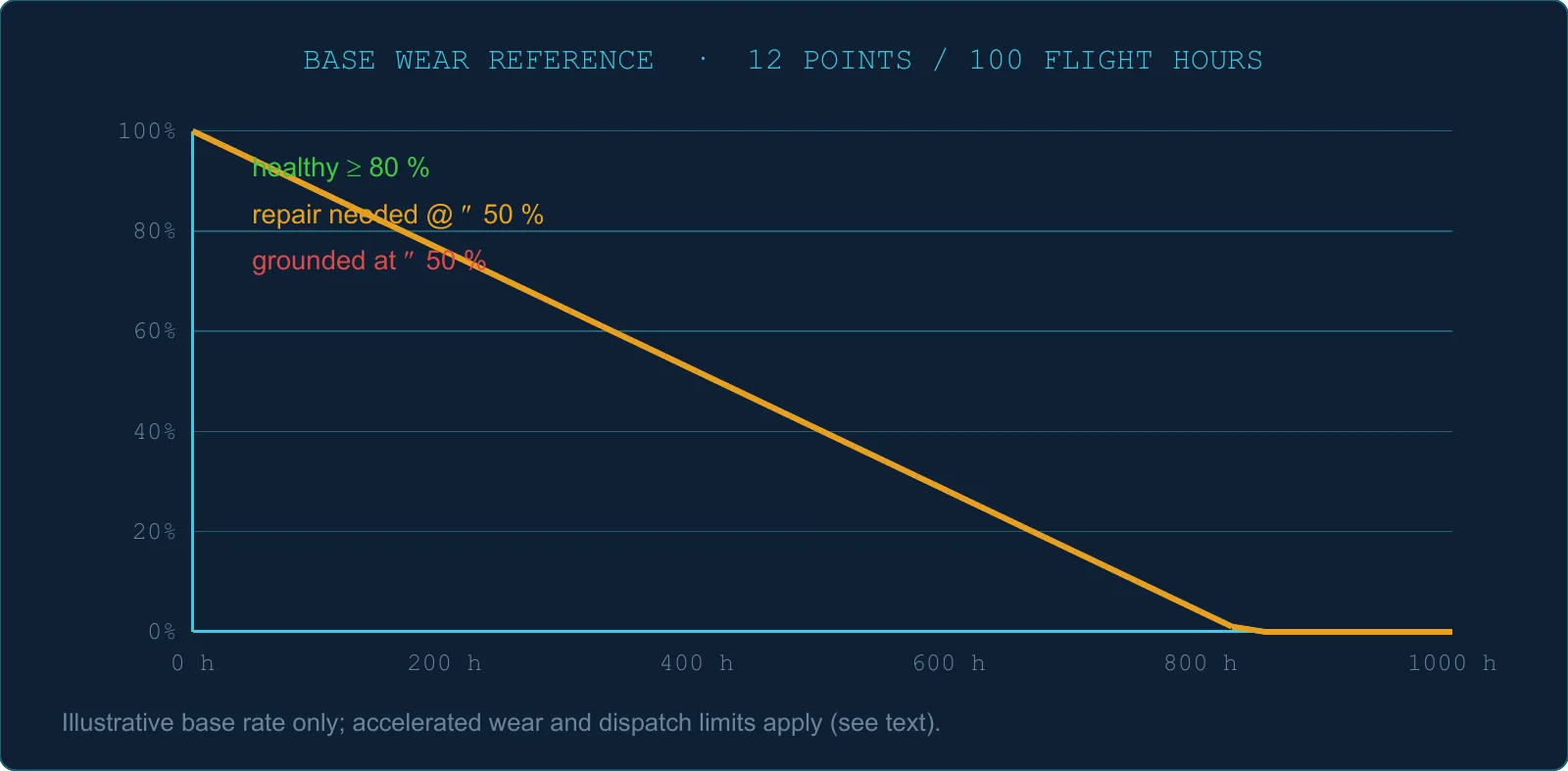
4.1 The 8 maintenance operations
There is no propeller maintenance — just these eight operations:
| Operation | Workshop Level | What it does when complete |
|---|---|---|
| Seat reconfiguration | None (paperwork only) | Changes the cabin layout (Eco / Business / First split) |
| Scheduled inspection | Level 1 | Resets the inspection countdown |
| Annual checkup | Level 2 | Resets the annual due date; the Companion also selects a periodic inspection |
| Failure repair | Level 1 | Removes all recorded aircraft failures |
| Airframe repair | Level 1 | Sets airframe condition to your chosen target |
| Airframe replacement | Level 2 | Airframe → 100 %, hours → 0, maximum condition → restored |
| Engine repair | Level 1 | Sets that engine's condition to your chosen target |
| Engine replacement | Level 2 | Engine → 100 %, hours → 0, maximum condition → restored |
Each engine is maintained individually. A twin-engine aircraft has two separate engine jobs.
Workshop level rule
- Level 1 required for: engine repair, airframe repair, scheduled inspection, failure repair.
- Level 2 required for: annual checkup, engine replacement, airframe replacement.
If the FBO has no workshop for the required level and class, the job is still accepted but a truck-call surcharge applies (see §4.11).
4.2 How maintenance is priced
All costs derive from a single base:
Maintenance cost = 70 % of the aircraft's hourly operating cost
So a Citation costs more to service than a Cessna 152 because its operating cost is higher.
Every quote starts with a 500 Cr paperwork & handling fee (10 min). If paperwork is the only line item, the fee collapses to zero.
FBO markup
When your aircraft is repaired at a player-owned FBO that isn't yours, the owner's markup multiplier is applied to the total price. System FBOs charge a random markup of +10 % to +110 %. Your own aircraft at your own FBO: no markup applied.
The markup portion is credited to the FBO owner immediately when the job starts.
4.3 Price breakdown
| Operation | Pricing formula (simplified) |
|---|---|
| Scheduled inspection | Hourly cost × inspection interval in hours × 0.02 |
| Annual checkup | Hourly cost × average annual flight hours × 0.007 |
| Engine repair | Hourly cost × condition loss % × a per-engine ratio |
| Engine replacement | Same as full repair (100 % condition loss), split across engine count |
| Airframe repair | Hourly cost × condition loss % × an airframe ratio |
| Airframe replacement | Calculated as a fixed 50 % delta — not a full rebuild |
| Failure repair (serious) | Equal to a full scheduled inspection cost |
| Failure repair (minor) | 20 % of a scheduled inspection cost |
| Seat change | 50 Cr per seat changed |
Inspection intervals by aircraft class
| Class | Interval |
|---|---|
| SEP, MEP, TurboProp, Helicopter | 100 h |
| Jet | 400 h |
| Heavy Jet | 600 h |
The inspection interval depends on the aircraft class. The price scales with the interval — a Heavy Jet inspection is expensive because it covers 600 hours of operation.
4.4 How long does maintenance take?
| Operation | Duration |
|---|---|
| Paperwork | 10 min |
| Scheduled inspection | 10 h |
| Annual checkup | 30 h |
| Engine replacement (per engine) | 10 h per engine |
| Engine repair (Δ%) | Δ × 100 × 12 min (e.g., 40 % repair = 480 min = 8 h) |
| Airframe repair (Δ%) | Δ × 100 × 12 min |
| Airframe replacement | 10 h |
| Failure repair — serious (condition ≤ 5 %) | 30 h |
| Failure repair — intermediate (condition 5–50 %) | 30 h |
| Failure repair — minor (condition > 50 %) | 2 h |
| Seat reconfiguration | 1 min per seat, max 30 min |
Example: repairing an engine from 60 % to 100 % (Δ = 40 %) → 480 min = 8 hours.
Airport boost
An airport boost can reduce maintenance time:
−10 % per boost level (Level 1 → −10 %, Level 2 → −20 %, etc.)
4.5 Mechanics — the workforce
Assignment is automatic. You do not pick which mechanic works on which aircraft.
Mechanic speed
Mechanic speed is governed by their Comfort and Punctuality personal stats (each from 0 to 1):
| Mechanic quality | Work speed |
|---|---|
| Poor stats (all at 0) | 0.90 work-hours per real hour |
| Average stats (all at 0.5) | 1.00 work-hours per real hour |
| Excellent stats (all at 1.0) | 1.10 work-hours per real hour |
How many mechanics can work at once
| Airport Size | Max working mechanics | Max simultaneous aircraft |
|---|---|---|
| 0 | 2 | 1 |
| 1 | 4 | 2 |
| 2 | 6 | 3 |
| 3 | 8 | 4 |
| 4 | 10 | 5 |
| 5 | 12 | 6 |
Additional aircraft queue up and wait.
Mechanics must be: assigned as Mechanic category, from your company, currently at the FBO's airport, and not busy transporting, training or relocating.
"Currently at" means physically there, and only Transport moves a mechanic.
Change base rewrites the home airport and nothing else — it does not move the employee, so it alone will never make a mechanic count for a workshop. Use
Transport to send him to the FBO's airport; he is in transit, and therefore not counted, until the trip ends.
Pooling your mechanics
All available mechanics' work power is pooled and split evenly across the aircraft currently being worked on. Assigning two mechanics to one aircraft cuts the clock time roughly in half.
System FBOs
No mechanics needed. Maintenance time at a system FBO runs in real time (1 h real = 1 work-hour, no speedup from extra mechanics).
4.6 The full maintenance flow
- Get a quote — your aircraft must be idle. If using a player FBO, at least one mechanic must be on-site.
- Start the job — cash check. If balance is sufficient, cargo and passengers on the aircraft are automatically unloaded. Aircraft status changes to Maintenance. The full amount is charged immediately.
- Maintenance progresses — driven by the scheduler every 15 minutes. Idle mechanics are assigned. Remaining work hours decrease based on pooled mechanic power.
- Job completes automatically — all changes (condition resets, etc.) are applied. Aircraft returns to Idle. You receive a notification.
- Cancel — you get back the base repair cost, but the markup already paid to the FBO owner is not refunded.
4.7 The scheduled inspection
- Countdown: decremented by actual flight hours at the end of every registered flight.
- Due: when the countdown hits 0, your aircraft is blocked until the inspection is done.
- Warning: shown when ≤ 5 hours remain.
- Intervals: 100 h (GA/TurboProp/Helicopter) · 400 h (Jet) · 600 h (Heavy Jet).
4.8 The annual checkup
- Calendar-based, not flight-hours. Due one year after the last checkup.
- Warning appears 15 days before the due date.
- Always requires Level 2 workshop for the aircraft's class.
- The annual operation does not restore condition or maximum condition. It resets the annual date. The Companion also selects the separate periodic inspection, which resets its own countdown. Neither is an airframe replacement.
- The annual line item is 30 work-hours before modifiers. In the Companion, selecting it also selects the periodic inspection, adding its separate work and cost to the quote; the full order is therefore not always 30 hours.
4.9 Damage model — how condition drops
Condition wears down on two parts separately: the airframe (the whole airframe) and each engine individually.
Base wear per flight
−12 % condition per 100 flight hours (both airframe and engine, under normal operation)
Below 80 % condition — wear accelerates
| Condition | Wear multiplier |
|---|---|
| 80 % | ×1.0 (normal) |
| 70 % | ×1.17 |
| 60 % | ×1.33 |
| 50 % | ×1.50 |
| 40 % | ×1.67 |
Practical meaning: below 80 %, the wear multiplier increases linearly as airframe condition falls; there is no new acceleration threshold at 50 %. At 50 % condition or below, the aircraft is blocked from flying until repaired.
The multiplier is set by the airframe's condition, and it applies to the engines' wear as well: an engine wears faster on a tired airframe, whatever its own condition.
Past hightime — wear accelerates further
Each aircraft type has a "hightime" threshold (total airframe hours). Past it, wear is multiplied by 1 + (hours past hightime ÷ hightime) — ×1.5 at one and a half times the hightime, ×2 at twice it — on top of the below-80 % factor. Because engine wear is derived from the airframe's, the engines wear faster too.
Maximum condition slowly decreases
Each flight also lowers the maximum possible condition slightly. Only a Replace restores a ceiling: an Airframe Replace for the airframe, an Engine Replace for that engine. See §4.10.
Engine TBO (Time Between Overhaul)
Once an engine's hours exceed the aircraft type's Time Between Overhaul:
That engine wears 3× faster — its condition AND its maximum condition.
| Per engine, base rate | Below TBO | Past TBO |
|---|---|---|
| Condition loss | 12 points / 100 h | 36 points / 100 h |
| Maximum-condition loss | 0.4 points / 100 h | 1.2 points / 100 h |
- The price of a repair point does not change past TBO — it depends on the aircraft type and on the workshop's markup, never on the engine's hours. What triples is the amount of repair each flight hour costs you.
- Only an Engine Replace resets the engine hours, and with them the TBO counter. A repair restores condition and leaves the hours where they are.
- At the same workshop, an Engine Replace costs exactly what repairing 100 condition points costs. Past TBO you spend at least 24 extra points per 100 h, so after at most about 420 flight hours past TBO the extra repairs have cost a new engine.
These are base rates: a tired airframe, hard landings and G-force excursions all make them worse (see below).
Flight events that cause extra damage
| Event | Extra damage |
|---|---|
| Hard landing | +0.2 % — airframe and each engine |
| Excessive G-force | Up to +0.25 % per event — airframe and each engine |
| Poor AI pilot stats | Up to +0.05 % per flight — airframe and each engine |
| Engine failure (sim event) | That engine's condition → random 0–50 % |
On an engine past TBO, its share of these losses is tripled like the rest of its wear.
Floor
Airframe condition cannot go below 0 %. An aircraft can reach 0 % and still exist — it just cannot fly until major repairs are completed.
4.10 Maximum condition — the slow, permanent ceiling
Why does my A350 only show 93 % maximum airframe condition with just 2 500 flying hours, when hightime starts at 52 000 h? Because maximum condition wears independently from current condition — and a Repair never fixes it.
Two conditions, not one
Each part of your aircraft (the airframe, and each engine separately) tracks two values:
- Current condition (0–100 %) — what your repair work touches. A new aircraft starts at 100 %; routine flying drops it; an Airframe Repair or Engine Repair brings it back.
- Maximum condition (0–100 %) — the ceiling the current condition can be repaired to. A new aircraft starts at 100 %; it slowly erodes over the aircraft's life; an Airframe Repair does not lift it, only an Airframe Replace can.
If your max airframe is 93 %, your repaired airframe condition can never exceed 93 % until you replace the airframe.
How the maximum drops
Every completed flight damages the current condition; the maximum drops by about 1/30th of that same damage. In practice this means the max wears roughly 30 times slower than the current condition.
What feeds the per-flight wear is identical to current-condition wear:
- Flight hours — the baseline driver.
- Hard landings — each one adds a chunk of extra wear that also bleeds into the maximum.
- Hightime airframe — once the airframe crosses its hightime threshold, every subsequent flight inflicts more wear than a fresh airframe; the maximum drops faster too. This is continuous, not a one-shot drop at the threshold. Because engine wear is derived from the airframe's, a hightime airframe also makes its engines' maximum drop faster.
- Engine past Time-Between-Overhaul — when an engine exceeds its TBO/SMOH limit, its maximum erodes about three times faster than under TBO. This is an engine-specific malus and does not affect the airframe's maximum.
Practical heuristic. A long-lived, well-flown aircraft will gradually drift to the 80–95 % max range from normal wear alone, with no hightime in sight. That's expected. The real maximum-eaters are hard landings and flying engines past TBO.
What restores the maximum
Only Replace operations bring the maximum back to 100 %:
| Operation | Effect on current | Effect on maximum |
|---|---|---|
| Airframe Repair | Sets to your chosen target | No effect |
| Engine Repair | Sets to your chosen target | No effect |
| Airframe Replace | → 100 % | → 100 %, hours reset to 0 |
| Engine Replace | → 100 % | → 100 %, engine hours reset to 0 |
There is no other automatic restoration: nothing scheduled, no daily drift fix, no skill, no airport service that lifts a maximum without a Replace work order.
Per-engine independence
The airframe maximum lives on the aircraft. Each engine has its own maximum. Replacing one engine does not touch the others, and does not touch the airframe. A 4-engine aircraft can easily end up with four different engine maxima depending on history.
Aircraft swap (admin / moderation)
When the moderation team performs an aircraft-type swap, the new engines inherit the average maximum of the engines they replace (default 80 % if there were none). This is a one-shot administrative operation, not a player tool.
4.11 No workshop at the FBO — the truck call
If the FBO has no workshop for the required level and aircraft class, the job is still possible but with a surcharge:
Truck call cost = (sum of other repair items) × 0.5 + 2 000 Cr Truck call time = 60 min extra
Anything done without a proper workshop is 50 % more expensive. Always check for a properly equipped FBO nearby before scheduling maintenance.
There is no parts shortage system. Parts are always available. No shipping delays or stock-outs. The surcharge is purely monetary.
4.12 Condition thresholds — when your aircraft is blocked
Your aircraft is blocked from flying when:
| Trigger | Threshold |
|---|---|
| Engine or airframe condition | ≤ 50 % |
| Scheduled inspection overdue | Countdown hits 0 |
| Annual checkup overdue | Calendar date passed |
| Any recorded failure | At least 1 failure on file |
A warning (not a block) appears when:
| Trigger | Threshold |
|---|---|
| Engine or airframe condition | 50 % < condition ≤ 60 % |
| Scheduled inspection | ≤ 5 hours remaining |
| Annual checkup | Within 15 days |
| Engine hours | Past Time Between Overhaul |
| Airframe hours | Past hightime threshold |
4.13 What does NOT exist
- ❌ No propeller maintenance — the model covers airframe + each engine only.
- ❌ No parts sourcing delays — parts are always available.
- ❌ No airport-size price modifier on maintenance cost itself (only the truck-call surcharge depends on having a workshop).
- ❌ Cancelling maintenance does not refund the markup paid to the FBO owner.
4.14 TL;DR
- Base price = 70 % of hourly operating cost for the aircraft type.
- Scheduled inspection: 100/400/600 h intervals depending on class. Price scales with the interval.
- Annual checkup: once a year, requires Level 2 workshop. Does not repair — compliance reset only.
- Condition drops 12 % per 100 flight hours, accelerating below 80 % and past hightime/TBO.
- Maximum condition wears 30× slower than current condition. Only an Airframe Replace or Engine Replace restores it to 100 % — repairs never lift the ceiling.
- Cancel refunds the repair cost but not the markup already paid to the FBO owner.
- No workshop at the FBO = +50 % and +2 000 Cr truck-call surcharge.
- Aircraft is blocked at condition ≤ 50 % or when inspection/checkup is overdue.
- Mechanic speed range: 0.90–1.10 work-hours per clock-hour (driven by Comfort & Punctuality stats).