
Industries
How do I turn an airport into a production hub? Why is my hunting camp underperforming? When can I drill for crude oil? Everything about factories, machines, production, supply & demand, and the Industry Points economy.
TL;DR — the key points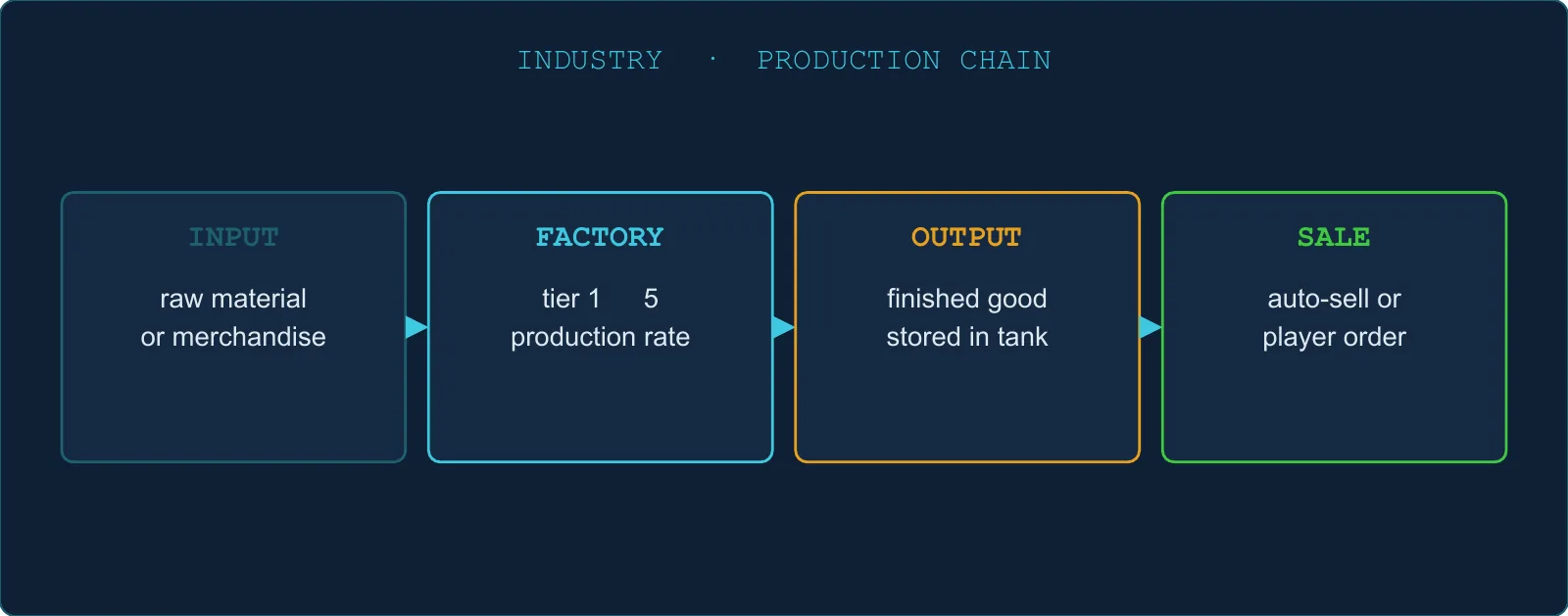
10.1 What industries are
OnAir Industries is a production sub-game layered on top of running an airline. You build a factory at an airport, place machines on a grid, connect input and output storage, hire work teams, and run recipes. What your factory produces can go to:
- Your own storage
- Your FBO's fuel tanks
- The Trading Hall (global marketplace)
- Other factories via truck transport
- Contracts signed against existing demand
Two separate economies run in parallel:
- Credits (Cr.) — the main game currency.
- Industry Points (IP) — a soft currency earned and spent only inside the industry system. No cash equivalent, no accounting line.
The airport ownership connection
The most important link between industries and the rest of the game: Airport Ownership Kits can only be produced by factories. You receive 10 free kits when you acquire an airport, but every weekly maintenance payment requires more — and only factories can make them. See the Economy chapter for airport ownership costs.
10.2 Building a factory
What unlocks factories
No skill tree investment required. Access is based purely on your company level.
- Maximum factories per company: 20 + company level.
- Maximum factories per airport: max(1, airport Size), so Size 0 and 1 each allow one, and Size 5 allows five. Basecamps allow five. This limit is shared by the non-archived factories of all companies in that world at that airport.
- You cannot build at someone else's basecamp.
Cost
Zero credits to create an empty factory. All costs come as you build, paid in IP and materials per machine and storage container.
Factory tiers and grid size
The tier determines how large your production floor is:
| Tier | Grid size | Upgrade cost | Weekly maintenance |
|---|---|---|---|
| 1 | 12 × 6 tiles | — | Free |
| 2 | 13 × 7 tiles | 10 Factory Extension Kits | 1 kit / week |
| 3 | 14 × 8 tiles | 35 kits | 2 kits / week |
| 4 | 15 × 9 tiles | 100 kits | 3 kits / week |
Tier 4 is the maximum. A Tier 5 tier does not exist.
Tier upgrades require Factory Extension Kits — a merchandise item that your own factories can produce (see §10.4). If you run out of kits, your Tier 2+ factory is frozen and all production stops.
Surface type restrictions
Each machine type requires a specific terrain: land, water, or forest. If your airport's surface doesn't match a machine's requirement, that machine is not available in the build menu.
10.3 Five factory categories
| Category | Terrain | What it specializes in |
|---|---|---|
| Wilderness | Forest | Hunting, fishing, fish processing — raw nature outputs |
| Mining | Land | Ore extraction (results depend on location — see §10.10) |
| Food | Land | Meat, fish, canning, mixed food, food rations |
| Manufactured Goods | Land | Plastics, electronics, batteries, kits |
| Dispatch Hub | Land | Special — wider input/output capacity, no production, pure logistics throughput. No tier upgrades, no worker teams. |
The Dispatch Hub is the warehouse pattern: route large volumes of goods through a central point. Use it to consolidate production from multiple remote factories before sending to the Trading Hall or other destinations.
10.4 The 28 machine types
| Machine | Category | Notes |
|---|---|---|
| Hunting Camp | Wilderness | Output depends on how remote the location is (see §10.10) |
| Large Hunting Camp | Wilderness | Higher output, same location rules |
| Fishing Camp | Wilderness | Location-sensitive |
| Logging Camp | Wilderness | Forest only — produces logs |
| Meat Smoker | Food | Raw meat → smoked meat |
| Tannery | Food | Fur → leather / pelt |
| Fish Smoker | Food | Fish → smoked fish |
| Fish Oil Extractor | Food | Fish → fish oil |
| Food Mixer | Food | Ingredients → mixed food / rations |
| Canning Platform | Food | Preserved / canned outputs |
| Mining Facility | Mining | Location-sensitive (ore deposits) |
| Small Mining Facility | Mining | Lower output, easier to start |
| Oil Well | Mining | Restricted to 18 geographic zones only (see §10.10) |
| Small Oil Well | Mining | Same zone restriction |
| Sawmill | Manufactured Goods | Logs → lumber |
| Ore Refinery | Manufactured Goods | Ore → bars / plates |
| Blast Furnace | Manufactured Goods | Iron ore → iron bars |
| Oil Refinery | Manufactured Goods | Crude oil → 100LL / Jet-A / asphalt |
| Metal Cutting Machinery | Manufactured Goods | Metal plates → parts |
| Electronics Facility | Manufactured Goods | Electronic components |
| Batteries Facility | Manufactured Goods | Lithium parts → batteries |
| Optics Facility | Manufactured Goods | Glass → optical components |
| Gear Facility | Manufactured Goods | Hunting / mining / fishing / oil-well gear |
| Training Center | Manufactured Goods | Trainers + training gear for worker upgrades |
| Travel Tokens Facility | Manufactured Goods | Crew transport currency |
| Factory Extension Facility | Manufactured Goods | Produces the kits needed to upgrade and maintain Tier 2+ factories |
| Airport Ownership Kit Facility | Manufactured Goods | Produces the kits required for airport ownership |
10.5 Six ways production can leave your factory
When a container is an output container, you choose where its goods go:
| Mode | What happens | You configure |
|---|---|---|
| Storage | Goods stay in the container. Production stalls when it's full. | Nothing — goods wait |
| Transport | Auto-sends a truck when the container reaches a threshold. | Threshold + destination airport |
| Trading Hall | Listed on the global market at your set price. Can auto-sell to the system at 60 % of base price. | Price + auto-sell toggle |
| Internal Transport | Routes goods to another factory you own. | Destination factory |
| FBO Refueling | Pipes fuel directly into one of your FBO tanks. | Target FBO |
| Local Dealer | Publishes fuel into the airport's dealer supply at your price. | Price per gallon |
Changing a container's merchandise type at any time moves the existing stock to your goods inventory — nothing is destroyed.
Container creation cost
| Container level | IP cost |
|---|---|
| Standard | Free |
| Large container | 70 IP |
Deleting a container refunds its IP cost.
10.6 The production cycle
When your factory ticks
The server processes factories every 3 minutes. A factory gets a processing tick if:
- A machine just finished construction or production, or
- It has been more than 6 hours since the last tick.
Up to 10 ticks happen per factory per processing pass.
When a machine starts producing
An idle machine starts a new cycle only after the following checks pass:
- Every machine input buffer is full. Stock elsewhere in the chain must first reach those inputs.
- Every machine output buffer is empty. Clear the previous batch before expecting the next to start; these are the machine's buffers, not every connected warehouse.
- Work groups are present, and at least one has efficiency of 20% or more.
- At least one work group is nourished. This is a separate check from the efficiency check.
- Enough Industry Points are available if the recipe spends IP.
How global efficiency affects production time
The server multiplies location efficiency by weighted staff efficiency, then adds any Industry boost to a positive result. This global efficiency, not staff efficiency alone, controls cycle duration:
| Global efficiency | Production time multiplier |
|---|---|
| 80 % or above | ×1.0 (normal speed) |
| 60 % | ×1.5 |
| 40 % | ×2.0 |
| 20 % | ×2.5 |
| 0 % | ×3.0 (3× as slow) |
The duration formula reaches normal speed at 80% global efficiency. An Industry boost adds 10/20/30 efficiency points; it is not a direct goods multiplier. Zero-efficiency duration is a formula reference, not a promise that an unstaffed, unfed or fully exhausted machine can start.
What happens when a cycle completes
- Output merchandise is added to the connected output containers.
- Industry Points are credited if the recipe generates them.
- Each work team's efficiency drops slightly based on how long the cycle took.
10.7 Work teams and food rations
A "work team" is one staffing slot on a machine. Each machine type has specific required team types (hunters, miners, fishermen, builders, etc.).
Eight worker types
Worker · Hunter · Builder · Foreman · Trainer · Lumberjack · Fisherman · Miner
The daily food ration cycle
Every day, each work team consumes food rations equal to the team size. If there aren't enough rations at the airport:
- The team is not fed → production halts for that team's machines.
- The client alerts you when you have less than 3 days of rations remaining.
Food rations are produced by your own factories (via the Food Mixer or Canning Platform) or can be purchased as cargo from the market.
Efficiency vs. being fed — two different states
| State | What it affects |
|---|---|
| Fed / Not fed | Fed → can produce. Not fed → halt. |
| Fatigue (0–100 %) | High → production is slower. 100% → production is 3× slower. |
A work team can be fed but exhausted (produces slowly), or rested but starving (produces nothing).
Replacing tired work teams
When a team's efficiency drops below ~60 %, the client alerts you. You can replace them with fresh workers drawn from the airport's worker supply. If none are available locally, the system can arrange a bus or boat transfer from a nearby airport — costed in Credits and IP.
The "Bulk Relieve" feature lets you replace all teams below a threshold at once.
10.8 Industry Points — the soft currency
| Action | Effect on IP |
|---|---|
| Recipe that generates IP (on cycle complete) | +IP |
| Recipe that costs IP (on cycle start) | −IP |
| Creating a large container | −70 IP |
| Worker bus/boat transfer | −IP (varies by distance) |
| Deleting a container | +IP refund |
| Deleting a factory | +IP refund for all machines and containers |
IP is shown in the interface as a colored pill — orange when positive, red when negative.
IP is not tracked in your financial accounts. It does not appear anywhere on your income statement or balance sheet. It is exclusively an industry resource.
10.9 Trading Hall — market, supply, and contracts
System supplies
The server automatically generates supply listings on the Trading Hall to ensure goods are available before players have factories. Key behaviors:
- System supplies last 7 to 22 days.
- Price varies ±30 % from the base price for each merchandise type.
- If you have a player factory selling the same merchandise within 200 NM of a system supply, the system supply is automatically disabled in that area. The system gets out of your way when you set up shop.
- Some common goods have unlimited supply available at any airport of sufficient size at base price.
Demand listings (buy orders)
Both the system and other players can post demand listings. Player demands are paid upfront at creation; the system refunds any unfilled portion if cancelled.
Contracts
You can sign a contract against an existing demand listing. Rules:
| Rule | Value |
|---|---|
| Contract duration | 7 days from signing |
| Auto-fulfillment | When matching merchandise arrives at the demand airport, stock transfers and Credits are credited automatically |
| Self-signing | Not allowed — you cannot fulfill your own demand |
Auto-sell to the system
If you enable auto-sell on an output container set to Trading Hall mode:
You receive 60 % of the merchandise's base price (40 % discount).
The benefit: zero market management, guaranteed income. The cost: you leave 40 % of potential revenue on the table.
10.10 Geography — where location matters
Some machines are location-sensitive. What's under the ground affects what they can produce.
Ore deposits
Each ore type has a "hotspot" radius. Smaller radius = rarer, you need to scout. Larger radius = easier to find a working location.
| Ore | Hotspot size |
|---|---|
| Lithium | Smallest (very narrow deposits) |
| Copper | Small |
| Bauxite / Graphite / Iron | Medium |
| Coal / Limestone / Crude Oil | Largest (most forgiving) |
Practical: if you're not near an ore deposit, your Mining Facility produces nothing useful. Check the in-game map tools before committing to a location.
Crude oil — 18 geographic zones only
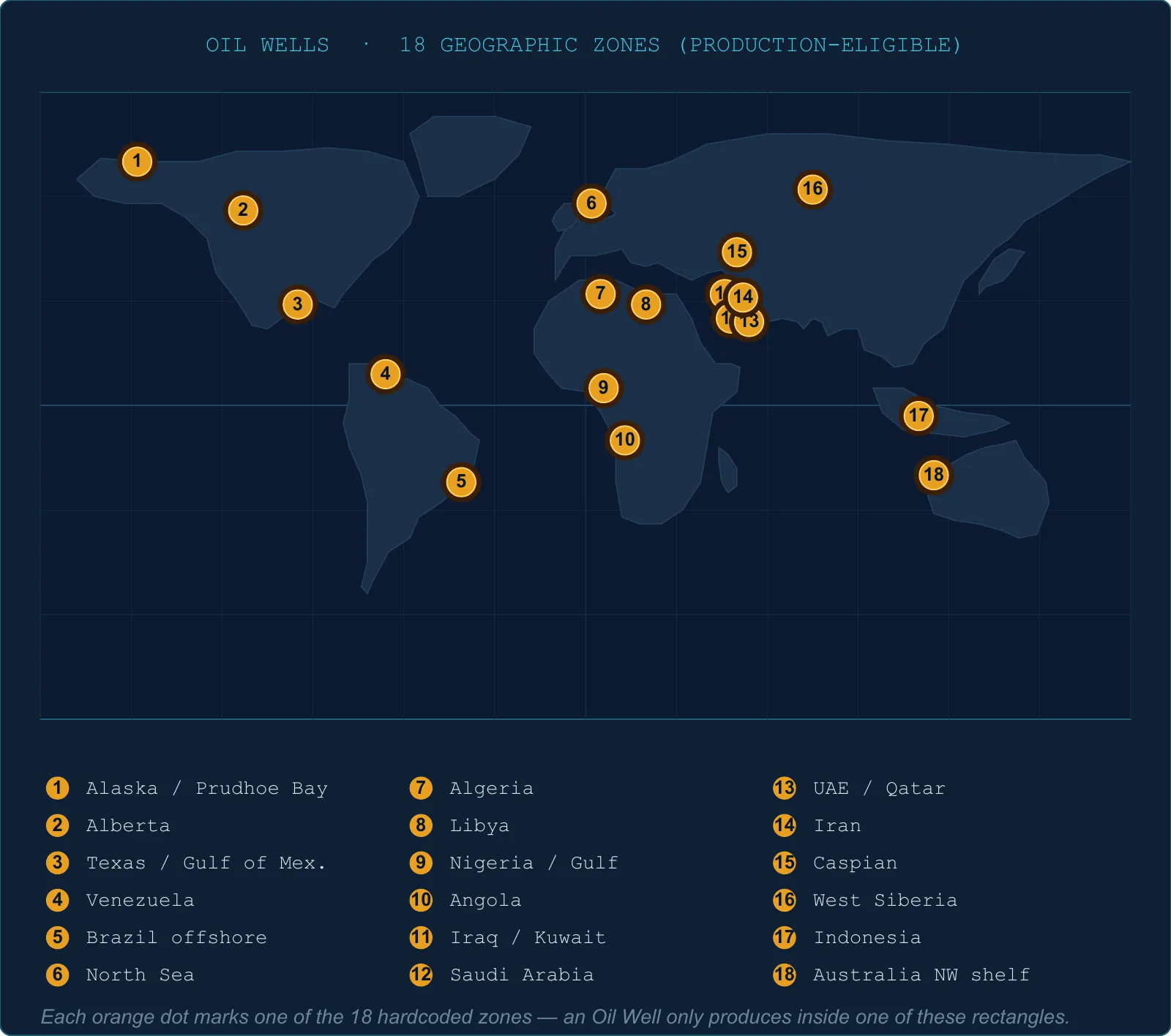
Oil Wells only function inside one of 18 hardcoded geographic rectangles. Key regions include:
| Zone | Real-world equivalent |
|---|---|
| Alaska / Canada / US East Coast | North America west and east |
| Texas / Gulf of Mexico / Caribbean | Southern North America |
| Venezuela / Colombia | Northern South America |
| Brazil | Eastern South America |
| Arctic Russia / Norwegian Sea | High north |
| North Sea (UK and Norwegian sides) | Northwestern Europe |
| North Africa / Sahara | Africa north |
| West Africa (Nigeria area) | Africa west |
| Southwest Africa (Angola) | Africa southwest |
| Siberia | Russia interior |
| Caspian / Kazakhstan | Central Asia |
| Middle East (Saudi Arabia, Iraq, Iran) | Middle East |
| India / Bangladesh | South Asia |
| Northeast China | East Asia |
| Indonesia / Southeast Asia | Southeast Asia |
| Australia | Oceania |
If your airport falls outside all 18 zones, an Oil Well has 0 efficiency — it produces nothing. Plan before building.
Hunting camps — the proximity penalty
Hunting Camps and Large Hunting Camps are penalized by nearby airports. Civilization scares the wildlife:
- Every airport within 30 NM applies a penalty weighted by its Size.
- Your home airport itself also applies a penalty.
Practical: hunting works best at remote basecamps deep in wilderness. A Hunting Camp at a large hub airport loses most of its efficiency before you even start.
10.11 Truck transport — moving goods between airports
When a container set to Transport mode reaches its threshold, an automatic truck delivery fires.
Travel time
Hours = (distance in NM × 1.5) ÷ 27 kts| Distance | Approximate time |
|---|---|
| 50 NM | ~2.8 h |
| 100 NM | ~5.6 h |
| 250 NM | ~14 h |
| 500 NM | ~28 h |
| 1 000 NM | ~56 h |
The 1.5× multiplier accounts for roads not being straight lines.
Cost (Credits)
500 Cr (fixed) + 2 × base rate × distance × total weightFuel output set to FBO Refueling has no transport charge within 250 NM; beyond that, the factory owner pays 10 Cr per tank per NM beyond 250 NM. This is separate from Local Dealer sales: the server buys whole 5,500-gal tanks from eligible player factories within 250 NM of an FBO, nearest first, when fuel is ordered or system restocking runs. Factories outside that radius are not used for Local Dealer purchases. See §3.10.
Cost (IP)
1 IP per unit shipped (free if the destination is the same airport).
On arrival
The transport delivers to the destination, attempts to fulfill any matching contracts automatically, and triggers worker replacement if the delivery included staff.
Industry goods can also be shipped as regular cargo missions. Workers travel as charter passengers; raw and refined goods travel as cargo. Your factory creates demand on the job board for nearby pilots.
10.12 Fees and factory lifecycle
Weekly maintenance fees (Tier 2+ only)
| Tier | Kits required per week |
|---|---|
| 1 | 0 (free) |
| 2 | 1 Factory Extension Kit |
| 3 | 2 kits |
| 4 | 3 kits |
If kits are not available at the factory's airport when fees are due:
- Factory enters Frozen state — all production stops.
- Retry happens automatically after 1 day.
The implication: a Tier 4 factory burns 3 kits per week — 156 per year. You need a dedicated Factory Extension Kit production line, or a reliable import contract, to keep high-tier factories running.
Inactivity archiving
A factory that has had no activity for 6 months is automatically archived:
- All IP spent on machines and containers is refunded.
- Construction materials are not refunded — they are lost.
- The archive is permanent. Unlike a paused-company archive (below), a factory archived for inactivity is never brought back — you rebuild from scratch.
The 6-month window is counted per factory, not per machine. Any activity anywhere inside the factory resets the clock for the whole site: a machine starting a production cycle, a machine completing one, a machine finishing construction, or goods moving from one container to the next.
The implication: a single machine still producing keeps the entire factory alive, idle machines included. Conversely, a factory where nothing at all happens ages as one block — there is no per-machine countdown to watch.
Paused company
If your company is paused (see the Economy chapter), all your factories are also archived. They can be revived when the company unpauses.
Manual deletion
Deleting a factory refunds all IP but does not refund construction materials.
10.13 How industries connect to the rest of the game
→ FBO fuel supply
A factory producing fuel (100LL or Jet-A) with output mode set to FBO Refueling pipes fuel directly into your FBO's tank. This is the only way to have fuel in your FBO that is cheaper than the world dealer price — and the only practical path to undercutting prices in Survival mode.
→ Airport ownership
Airport Ownership Kits are produced only by the Airport Ownership Kit Facility. The weekly kit consumption ramps steeply with airport size (up to 50 kits per week at Size 5). Without an industry production line, owning a large airport is unsustainable long-term.
→ Cargo and charter missions
Industry workers and goods use the same mission system as regular jobs:
- Workers and specialized staff → travel as charter passengers.
- All raw and refined goods → shipped as cargo.
Every time you expand a remote factory, you generate a wave of cargo and charter demand for nearby pilots.
10.14 The merchandise catalog
Staff (travel as charter passengers)
Worker · Hunter · Builder · Foreman · Trainer · Lumberjack · Fisherman · Miner
Food chain
Raw Meat · Smoked Meat · Fur · Pelt · Leather · Fish · Smoked Fish · Fish Oil · Mixed Food · Vegetables · Food Rations
Mining & metals
Copper Ore · Lithium Ore · Iron Ore · Bauxite · Graphite Ore · Coal · Limestone Copper Plate · Lithium Bar · Iron Bar · Aluminium Plate · Graphite Block Copper Part · Lithium Part · Aluminium Part · Graphite Part
Energy / Oil
Crude Oil Tank · Oil Well Gear · Asphalt · 100LL Fuel Tank (5 500 gal) · Jet-A Fuel Tank (5 500 gal)
Manufactured goods
Plastic · Glass · Electronic Component · Battery · Opticals · Luxury Products · Steel Bar · Lumber · Log
Gear
Hunting Gear · Fishing Gear · Mining Gear · Logging Gear · Training Gear · Ore Detector · Sulfuric Acid
Strategic outputs
| Item | Why it matters |
|---|---|
| Factory Extension Kit | Required to upgrade and maintain every Tier 2+ factory. Without this, your upgrade path stops. |
| Airport Ownership Kit | The only way to sustain long-term ownership of large airports. |
| Construction Kit | Used to install a basecamp at a new location. |
10.15 Strategic patterns
Self-sustaining Tier 2+ factories
Above Tier 1, every factory needs Extension Kits weekly. Build a Factory Extension Facility early to produce your own, or maintain a steady contract supply from another player. Going Tier 3 or 4 without a kit pipeline is how factories freeze.
The remote wilderness pattern
Hunting and ore-mining machines reward isolation. A basecamp deep in forest with no nearby airports is the best location for a Hunting Camp. Every airport within 30 NM drains efficiency. A large hub is the worst possible spot for a Hunting Camp.
The spoke-and-wheel pattern with a Dispatch Hub
Build a Dispatch Hub at a large airport (Size 4–5) and raw extraction facilities at remote basecamps. The basecamps feed the hub via truck transport. The hub routes to the Trading Hall, FBOs, or refinement factories.
Auto-sell vs. Trading Hall trade-off
| Strategy | Pros | Cons |
|---|---|---|
| Auto-sell to system (60 % of base) | Zero management, predictable cash flow | 40 % revenue loss on every unit |
| Trading Hall pricing | Full margin potential | Requires managing demand; inventory piles up if demand is slow |
For high-demand goods (Food Rations, Lumber), the Trading Hall pays. For slow-moving specialty items, auto-sell is safer.
The airport ownership pipeline
If you target Size 4–5 airport ownership, plan a dedicated production line:
Iron / Copper / Lithium ore → refined plates → parts → Electronics → Airport Ownership Kits
For example, 50 human flights × 2 000 Cr = 100 000 Cr at a Size 5 airport, before the human-only-world doubling. That revenue depends on traffic, not a guaranteed boost-level income. Kit production must still cover the 50 kits/week ownership cost and any active boosts.
10.16 What industries are NOT
- ❌ No skill tree required — only company level gates access.
- ❌ No upfront credit cost to create a factory — only IP and materials as you build.
- ❌ No system-owned factories — all factories are player-owned. The system only posts supply and demand listings.
- ❌ No condition decay on idle machines — machines do not degrade from sitting unused.
10.17 TL;DR
- Factories cost zero Credits to create — only IP and materials as you build.
- Tiers 1–4: grids 12×6 to 15×9. Upgrade cost: 10 / 35 / 100 kits. Maintenance: 0 / 1 / 2 / 3 kits per week.
- Production time uses global efficiency, including location and boosts. Starting a cycle also requires full inputs, empty outputs and eligible staff.
- Workers need Food Rations daily. No food → no production.
- Six output modes: Storage, Transport, Trading Hall, Internal Transport, FBO Refueling, Local Dealer.
- Auto-sell to system = 60 % of base price — a 40 % discount for zero management.
- System supplies pause within 200 NM of a player factory selling the same merchandise.
- Crude oil works only in 18 hardcoded zones (Texas, North Sea, Middle East, Indonesia, Australia, etc.).
- Hunting Camps are penalized by every airport within 30 NM — go remote.
- Factory Extension Kits are your Tier 2+ lifeline — produce them or import them.
- Airport Ownership Kits can only come from factories — there is no other source.
- Inactive factory = archived after 6 months (IP refunded, materials lost) — counted per factory, so one producing machine keeps the whole site alive.