
Fleet & Aircraft
How much is my 10-year-old Caravan worth today? What's the penalty for returning a rental with half-empty tanks? How does aircraft pricing actually work? Everything about aircraft lifecycle, pricing, rental, and leasing.
TL;DR — the key points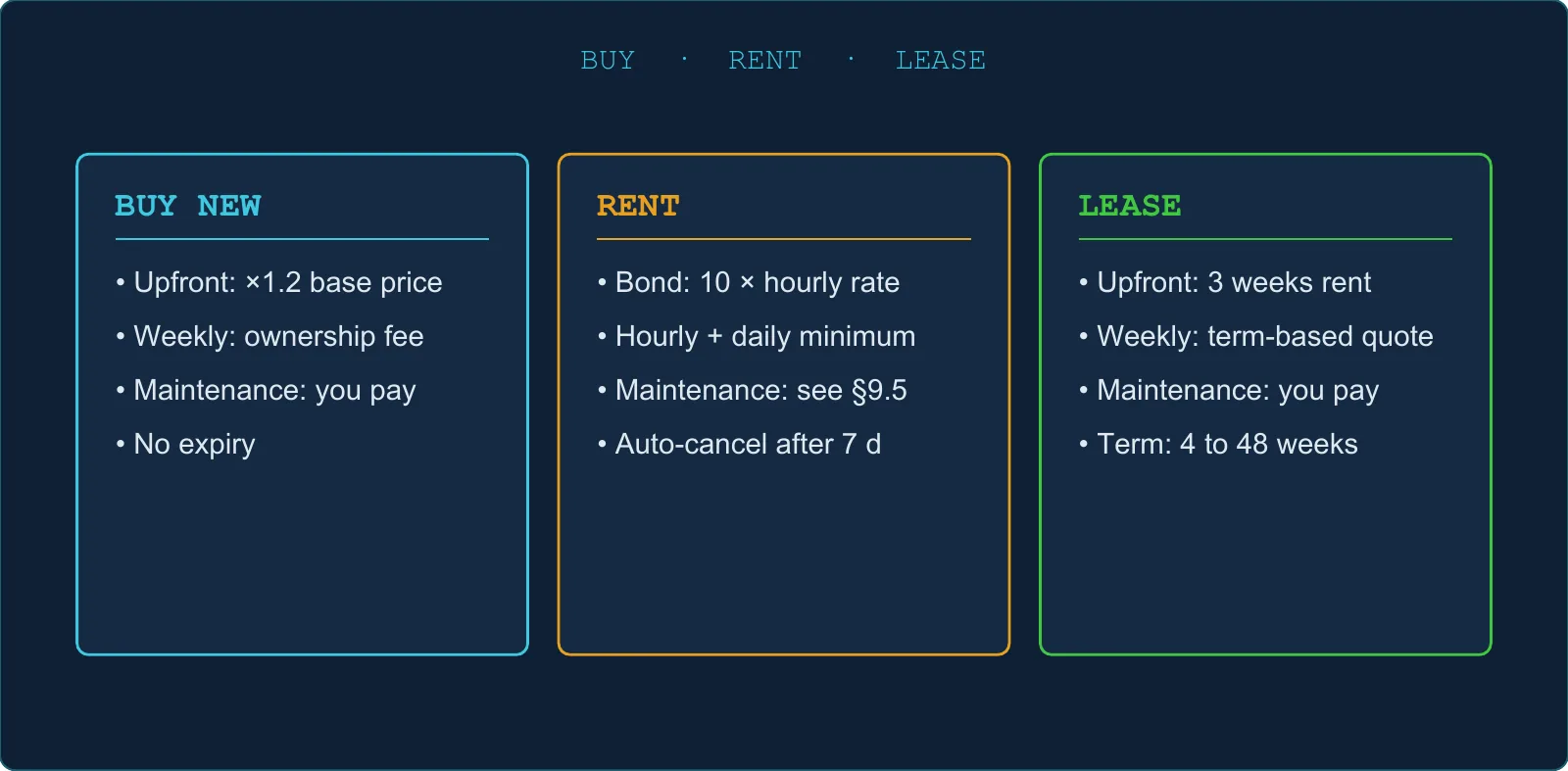
9.1 Three ways to have an aircraft
| Mode | Upfront cost | Recurring cost | When it ends | Maintenance |
|---|---|---|---|---|
| Buy new | Base price × 1.2 | Weekly ownership fee | Never | You pay |
| Buy used (market) | Roughly market value (with small random jitter) | Weekly ownership fee | Never | You pay |
| Rent | Security bond (10 × hourly rate) | Hourly on flight time + daily if below minimum hours | Auto-terminated (see §9.5) | Depends on system/player ownership; see §9.5 |
| Lease | Three weeks of the quoted rent | Weekly payment adjusted for the selected term | After 4–48 weeks, as selected | You pay (not included) |
9.2 How aircraft are priced
The base price formula
The server calculates each aircraft type's price from scratch using its real performance data:
- Total workload = how much the aircraft can carry at cruise speed — combining cargo capacity, seat count, and cruise speed.
- Hourly operating cost = derived from workload using a smooth curve anchored between a Cessna 172 (baseline) and a B747 (high end).
- Weekly ownership fee = hourly operating cost minus fuel and pilot, multiplied by expected weekly hours:
| Aircraft class | Expected hours per week |
|---|---|
| SEP, MEP, TurboProp, Helicopter | 14 h |
| Glider | 7 h |
| Jet | 21 h |
| Heavy Jet | 28 h |
4. Base price = weekly ownership fee × 24 (amortized over 24 weeks), rounded down to nearest 100 Cr.
New aircraft surcharge
Default new-aircraft multiplier: Base price × 1.2 (+20%). This is a configurable server setting; use the purchase quote for the active price.
When prices are recalculated
- After any aircraft-type update by the moderation team.
- Every Monday around 05:15 UTC as part of the weekly maintenance cycle.
The 10 % update threshold
If a price recalculation would change an existing aircraft's value by less than 10 %, the update is skipped. If the change is 10 % or more, existing aircraft owners receive a credit or debit for the difference, and the aircraft's "for rent" and "for sale" flags are reset.
9.3 Market value and how it depreciates
How value is calculated
Market value = Base price − cost of all deferred repairs"Deferred repairs" includes: airframe condition shortfall + each engine condition shortfall + overdue scheduled inspection + overdue annual checkup.
There is no age-based depreciation. An aircraft does not lose value just from being old. Value drops only as condition drops — age matters only because more hours mean more wear.
Hightime impact
Hightime increases subsequent wear, indirectly increasing deferred repair costs. The current market-value calculation adds no separate hightime percentage discount. After subtracting deferred repairs, the result is truncated to hundreds of Credits and floored at 1 000 Cr.
Selling to the system
Market value × 0.83 (−17 % haircut)
Where this value lives in your books: the fleet line of your Balance Sheet tracks this market value. Buying an aircraft never touches the Income Statement — it is an asset swap, cash for aircraft (see §8.6) — and wear reaches your books as declining fleet value here.
9.4 Used aircraft from the market
When a used aircraft is generated for the market:
| Field | Range |
|---|---|
| Airframe hours | 0 to 1.5× hightime threshold |
| Engine hours | 0 to just below Time Between Overhaul |
| Price jitter | ×0.98 to ×1.08 |
Time Between Overhaul defaults (before any moderation)
| Class | Default TBO |
|---|---|
| SEP | 1 200 h |
| MEP | 3 000 h |
| Helicopter | 1 000 h |
| Jet | 2 200 h |
| Heavy Jet | 2 500 h |
Freshly spawned new aircraft
A new aircraft has 1–5 flight hours (near zero), 100 % condition on all parts, and full performance specs.
9.5 Rental mechanics
Hourly rate
The rental rate is calculated from the aircraft's maintenance cost portion plus a margin above operating cost. There is a floor of 50 Cr/h.
Security bond
Bond = hourly rate × 10Charged when you sign the rental agreement. Returned (minus penalties) when you return the aircraft.
Daily minimum flight hours
Rentals require a minimum number of hours flown per day:
| Class | Min hours per day (Realistic setting) |
|---|---|
| SEP, MEP, TurboProp, Helicopter, Glider | 1 h |
| Jet | 2 h |
| Heavy Jet | 4 h |
| Human-only world | 0 h (no minimum) |
Your rental intensity setting reduces this requirement:
| Setting | Hours required |
|---|---|
| Realistic | Full minimum |
| Medium | 50 % of minimum |
| Low | 25 % of minimum |
If you fall short of the daily minimum, the shortfall is charged at 05:15 UTC each day.
Auto-termination
A rental is automatically cancelled if:
- 7 days pass without a registered flight.
- The aircraft requires mandatory maintenance.
Maintenance during a rental
System rentals and rentals from another player do not have identical maintenance permissions. The server can refuse configuration of an aircraft while a player-to-player rental is active. An accepted maintenance order is charged to the company placing it; do not assume that all rental maintenance is free or always available to the renter. Leasing separately makes maintenance your responsibility. Read the workshop or return quotation for the aircraft concerned.
Rental return penalties
| Infraction | Penalty |
|---|---|
| Missing fuel | Missing gallons × local max fuel price × 2.0 |
| Returned at wrong airport | Round-trip rent fee + fuel + pilot cost + +10 % paperwork |
9.6 Lease mechanics
- Terms offered: 4, 8, 12, 24, 36 or 48 weeks.
- Upfront: three weeks of the selected weekly rent. Later weekly deductions begin after that prepaid period.
- Base weekly rent: weekly ownership fee × 1.2. The longer terms divide that base by 1.05 / 1.10 / 1.15 / 1.20 for 12 / 24 / 36 / 48 weeks. The resulting reductions are approximately 4.76 / 9.09 / 13.04 / 16.67%; 4 and 8 weeks use the base rate.
- Maintenance: not included — you pay separately.
- Payments are deducted automatically each week. On expiry the aircraft returns to its owner.
- After the lease ends, the aircraft is cleaned up automatically within 15 days.
Early termination
25 % of the unused contractual weeks, with any unused prepaid whole weeks refunded separately. The started week counts as consumed; the live return quote shows both amounts.
End-of-lease condition penalty
If the aircraft is returned in worse condition than when you received it:
Penalty = condition shortfall × full repair cost × 1.25Applied to both airframe and each engine.
9.7 Test-flight onboarding (player addon certification)
If you own a third-party aircraft addon that isn't yet in the OnAir database, you can submit it through a test-flight process.
What your simulator provides automatically
Cruise speed, stall speeds, empty weight, max takeoff weight, fuel capacity, fuel type, engine type, cruise fuel flow, seat count, max payload, display name, and a unique addon hash.
What you can optionally supply
| Field | Rule |
|---|---|
| Addon download URL | Must be a valid http(s):// URL or the word "default" |
| Data sheet URL | Optional |
| Proposed seat count | Used if you supply a number greater than 0 |
| Proposed max payload | Used if you supply a number greater than 0 |
Test-flight aircraft conditions
The test aircraft is generated with 1–5 hours on the airframe, 100 % condition everywhere, and 50 % fuel.
Fly at least 20 minutes airborne and include a detected cruise phase before registering. Gliders are exempt from the cruise-phase condition, but still need twenty minutes. No separate minimum distance is imposed by this test.
After the test flight
Once you complete the test flight, your addon enters the moderation queue. A moderator reviews it and either approves it, marks it banned (with a reason), or asks you to redo the test flight.
9.8 Aircraft cargo capacity
For every aircraft type, the server calculates how much payload is realistically available:
Maximum payload = aircraft total capacity minus half-fuel weight, minus standard pilot weight, minus copilot weight if applicable.
Fighters have slightly different rules — their cargo limit is calculated directly from the max takeoff weight.
Short-range aircraft
Short-range aircraft (under ~500 NM) are limited to using only 60 % of their theoretical maximum payload. This scales up toward ~97 % for longer-range aircraft. It is a balance design decision.
9.9 Parking — no condition impact
Your aircraft's condition does not decay while parked. Indoor hangar, outdoor tie-down, or apron — it makes no difference.
Condition only changes from flight hours and specific in-flight events. A grounded aircraft stays at exactly the same condition indefinitely.
9.10 Reference constants
| Constant | Value |
|---|---|
| Standard passenger weight | 190 lbs |
| Standard seat weight | 63 lbs |
| New aircraft price multiplier | ×1.2 |
| Weekly ownership amortisation | 24 payments |
| System sell haircut | −17 % |
| Rental bond | 10 × hourly rate |
| Rental floor rate | 50 Cr/h |
| Owned vs rented cost advantage | 2 % per hour |
| Rental missing-fuel penalty | ×2.0 on gallons' value |
| Lease weekly premium | ×1.2 over ownership |
| Lease early termination penalty | 25 % of remaining payments |
| Lease condition shortfall multiplier | ×1.25 |
9.11 TL;DR
- New aircraft = Base price × 1.2. Used aircraft start lower depending on condition and hours.
- No age-based depreciation — value = base price minus accumulated repair backlog.
- Hightime affects future wear; the current market-value calculation has no separate −25% discount.
- Rental bond = 10 × hourly rate. Return with missing fuel → ×2.0 penalty on the missing gallons' value.
- Lease = 4–48 weeks, with three weeks paid upfront and a term-dependent weekly quote. Early return fees and unused advance refunds are itemised in the quote.
- No condition penalty for parking — not indoors, not outdoors, not at any airport.
- A test flight requires 20 minutes airborne and a detected cruise phase (cruise exempt for gliders).