
Plan Your First Industrial Activity
Industry uses goods, workers and time to produce other goods. A recipe can earn or consume Industry Points; construction has its own separate IP cost. Positive production IP is earned when the cycle completes. Negative production IP is spent when it starts, and an insufficient balance prevents that cycle from starting. Before creating machinery, choose one output and establish how its inputs will reach the site and how its output will leave. Credits and Industry Points are different resources: a large cash balance does not automatically satisfy an IP requirement.
Step 1. Choose one product to understand
Open Industries Encyclopedia, then Production Lines. Select Food Rations for this exercise. The description explains that every worker needs one ration per day to keep working. Rations therefore have an operational use as well as potential market demand.
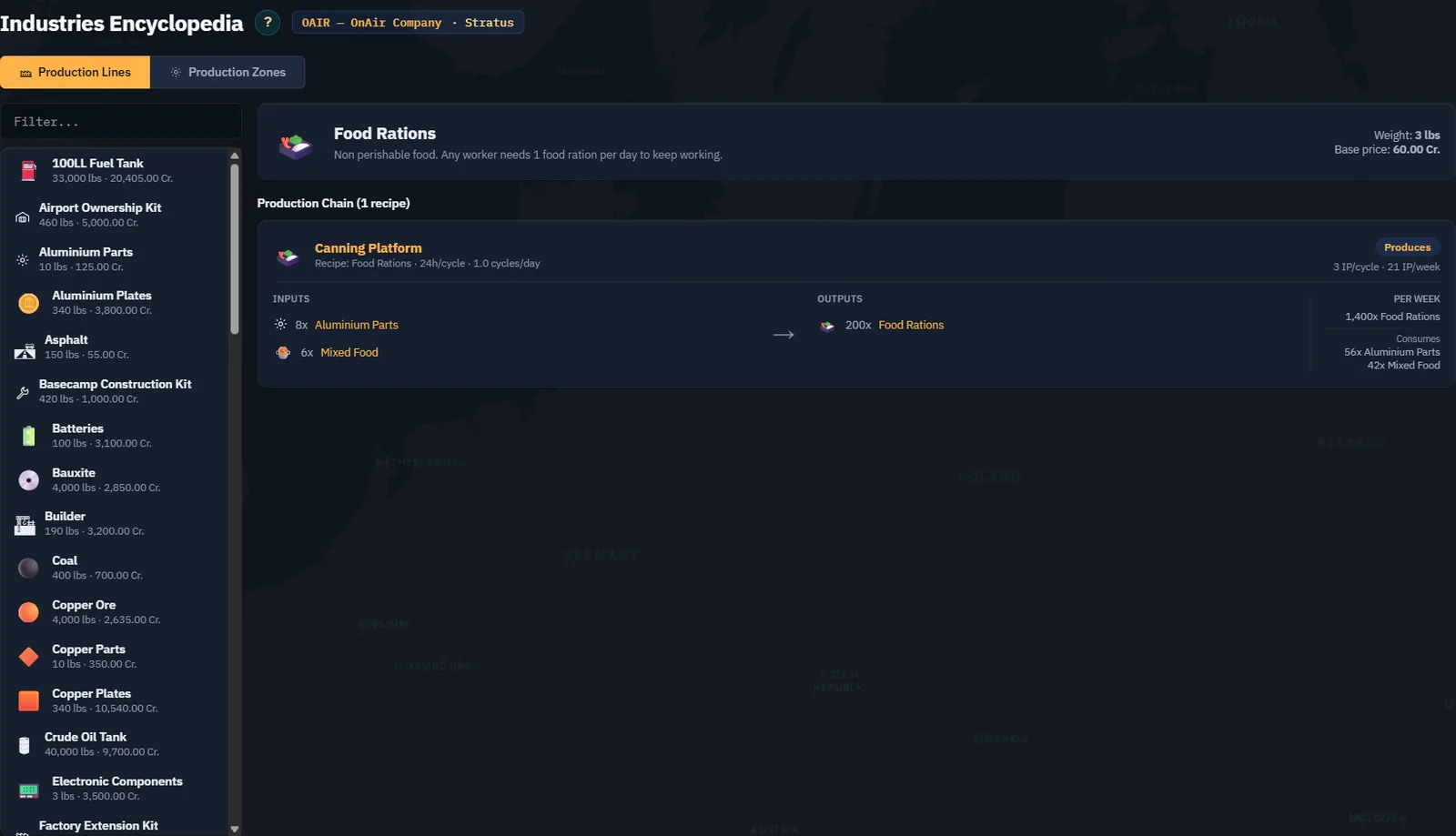
The captured recipe consumes 8 Aluminium Parts and 6 Mixed Food to produce 200 Food Rations, with 24 hours per cycle and 3 IP per cycle. Read quantities as units of each merchandise, then use their unit weights for transport planning.
Step 2. Convert the recipe into a supply plan
At the displayed ideal rate, one week consumes 56 Aluminium Parts and 42 Mixed Food, producing 1,400 rations and earning 21 IP. That is an uninterrupted full-speed calculation, not a production promise. Construction, missing goods, tired workers and output congestion reduce actual throughput. This food recipe earns IP, but other recipes consume them: the inspected definitions include Travel Token (-250 IP/cycle), Factory Extensions Parts (-100) and Airport Ownership Kit (-3). Check the live recipe and budget recurring consumption as well as the separate construction cost.
Start by budgeting one cycle, then a supply reserve. Identify where both input goods are offered and whether they can be bought at the factory airport. If transport is needed, include its cost, weight and delivery delay. An item owned at another airport cannot simply be counted as available here.
Step 3. Inspect the machine behind the recipe
Click Canning Platform to open its Production Zones detail.
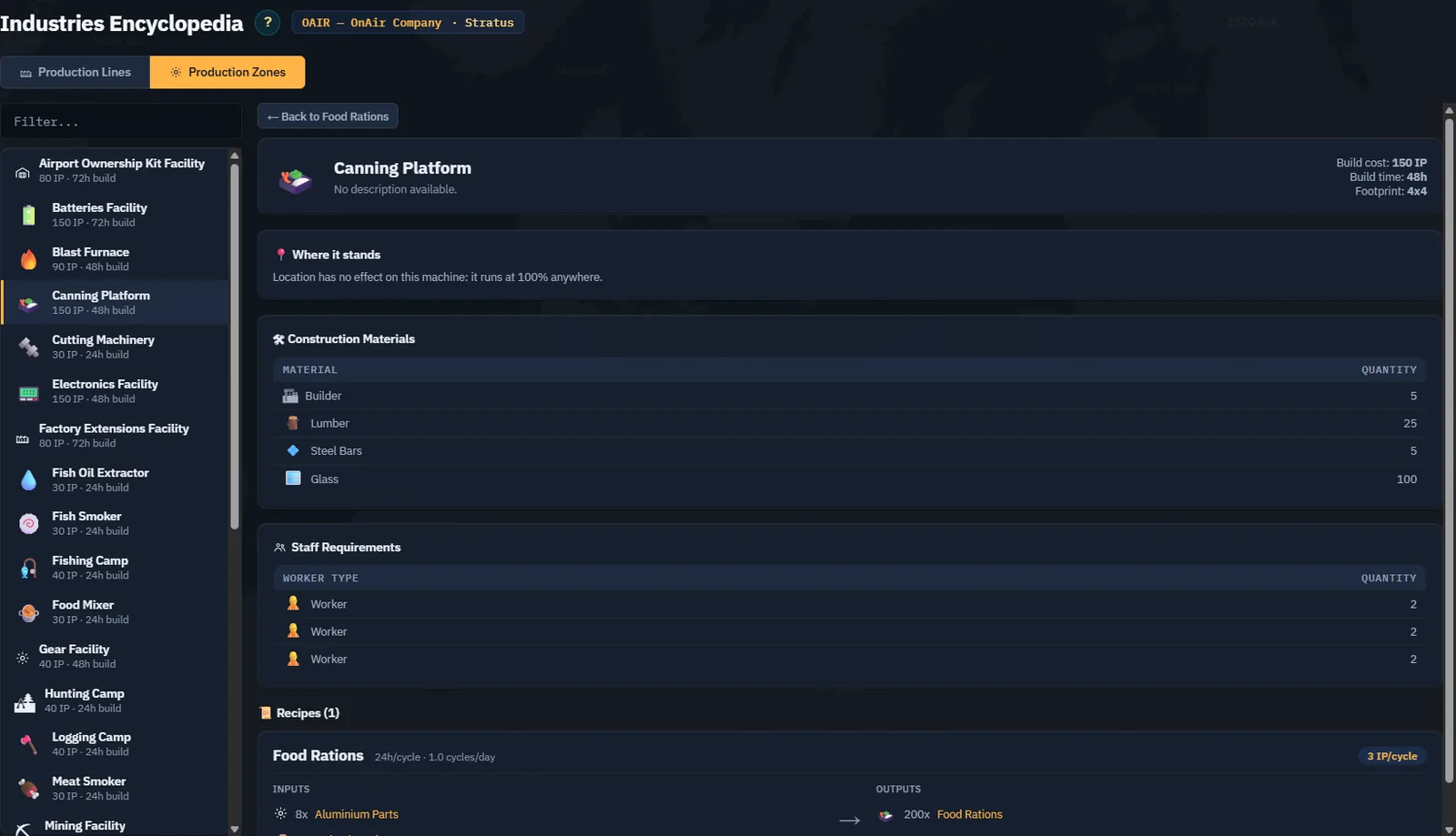
Construction requires 5 Builders, 25 Lumber, 5 Steel Bars and 100 Glass. Staff requirements show three groups of two Workers. Keep construction resources separate from the workforce and materials used during normal production.
The inspected OAIR factory showed 50 available IP. That is below this machine's 150-IP build requirement, even if sufficient credits are available to buy materials. This lesson therefore documents the plan and existing installation; it does not claim a new Canning Platform was built.
Step 4. Budget the complete start
Include construction goods and their delivery, the machine's IP requirement, operating staff, food for those staff, the first recipe inputs, containers and any applicable facility costs. Then add a reserve for continued cycles and replenishment.
For the six workers shown here, six rations per day is the basic food requirement once those workers are active. Count other active workers at the same airport too. A ration-producing factory still needs workers fed before its first output exists.
Step 5. Choose location for the whole activity
For this food example, access to supplies and transport matters more than mineral deposits. Compare airports with your existing network and the market. A terrain-independent machine can still be expensive to supply at a remote location.
Mines and oil wells need a different location investigation because deposits affect efficiency. Read the relevant machine's location explanation before choosing a site. Do not transfer the Canning Platform's terrain rule to extraction machinery.
Screenshot placeholder IP05 — resource survey flight. For a later mining or oil example, load the Ore Detector, follow the game's survey requirements in a suitable simulator flight and capture the actual detector readings with location. Explain that this is an OnAir gameplay illustration; do not invent a rich deposit or use the food-factory screen as survey evidence.
Step 6. Decide how output will leave
Choose whether the first output will be stored, used by your workers, sold or transported. Check the intended buyer or destination before assuming all production becomes revenue. Plan enough output capacity for the interval between collections.
Checkpoint: you can name the product, recipe, machine, construction resources, operating inputs, workers, food requirement, IP budget and destination of the output. The next chapter turns that plan into a factory layout and explains the construction gates.