
Keep the Fleet Ready to Fly
A purchased aircraft is not a promise of uninterrupted service. Before committing it to another mission, check its location, status, inspections, condition and configuration. This chapter uses N5454S, the Cessna purchased in Chapter 7, to read the workshop and obtain a real quotation.
Step 1. Inspect before scheduling
Open Fleet, expand the aircraft and read its readiness information. Compare inspection time remaining with the operation you intend to fly. Check active failures and aircraft status as well as the condition percentages. An aircraft already in maintenance cannot be treated as available just because its location matches the departure.
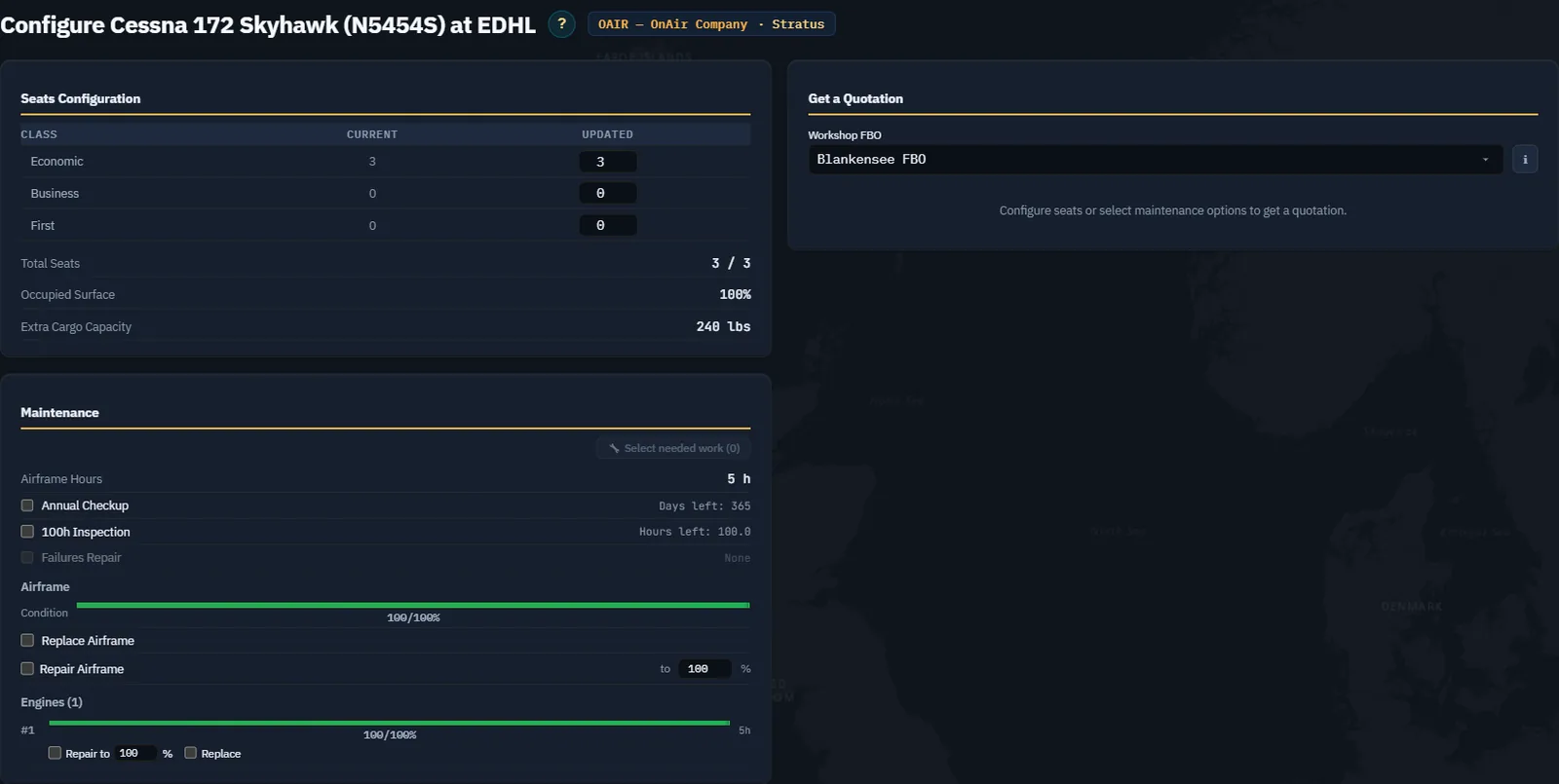
Choose Workshop for the detailed maintenance and cabin screen. Our new aircraft shows 365 days before its annual check, 100 hours before its 100h inspection, and airframe/engine condition of 100/100%. It does not currently need the demonstration inspection.
Step 2. Find a compatible workshop
Select Workshop FBO at the aircraft's airport. The example offers Blankensee FBO at EDHL. Use its information button to examine the available services before choosing the work.
If no compatible workshop exists at the field, use the displayed nearby alternatives or Find FBO. Check that the workshop covers the aircraft class and the intended operation. An annual inspection needs the appropriate annual capability. Plan a ferry only if the aircraft is allowed to fly, and include crew, fuel and time in that decision.
Screenshot placeholder MR03 — workshop repositioning. On an aircraft that genuinely needs another airport, capture the no-compatible-workshop panel, chosen suitable FBO, ferry dispatch and arrival. Explain the actual aircraft's ability to fly; do not imply a grounded aircraft can always be ferried normally.
Step 3. Select only the work required
For an inspection, choose 100h Inspection or Annual Checkup as appropriate. Annual includes the 100h inspection; do not budget them as two independent mandatory jobs. Failures Repair applies to actual failures and is disabled when there are none.
For condition work, distinguish a repair target from a replacement. Repair Airframe to requests a resulting condition, not a percentage to add. The reachable ceiling can be below 100% on an ageing aircraft. Engines have their own repair/replacement choices. Replacing a sound component just to raise an already adequate number spends money without resolving an operational need.
Step 4. Read the quotation and downtime
Choose Get Quotation. Our demonstration selects a 100h inspection and receives 1,519.54 Cr. with 10h 10m downtime. The detail includes 500 Cr. paperwork and handling, 388.62 Cr. inspection and 630.92 Cr. markup.
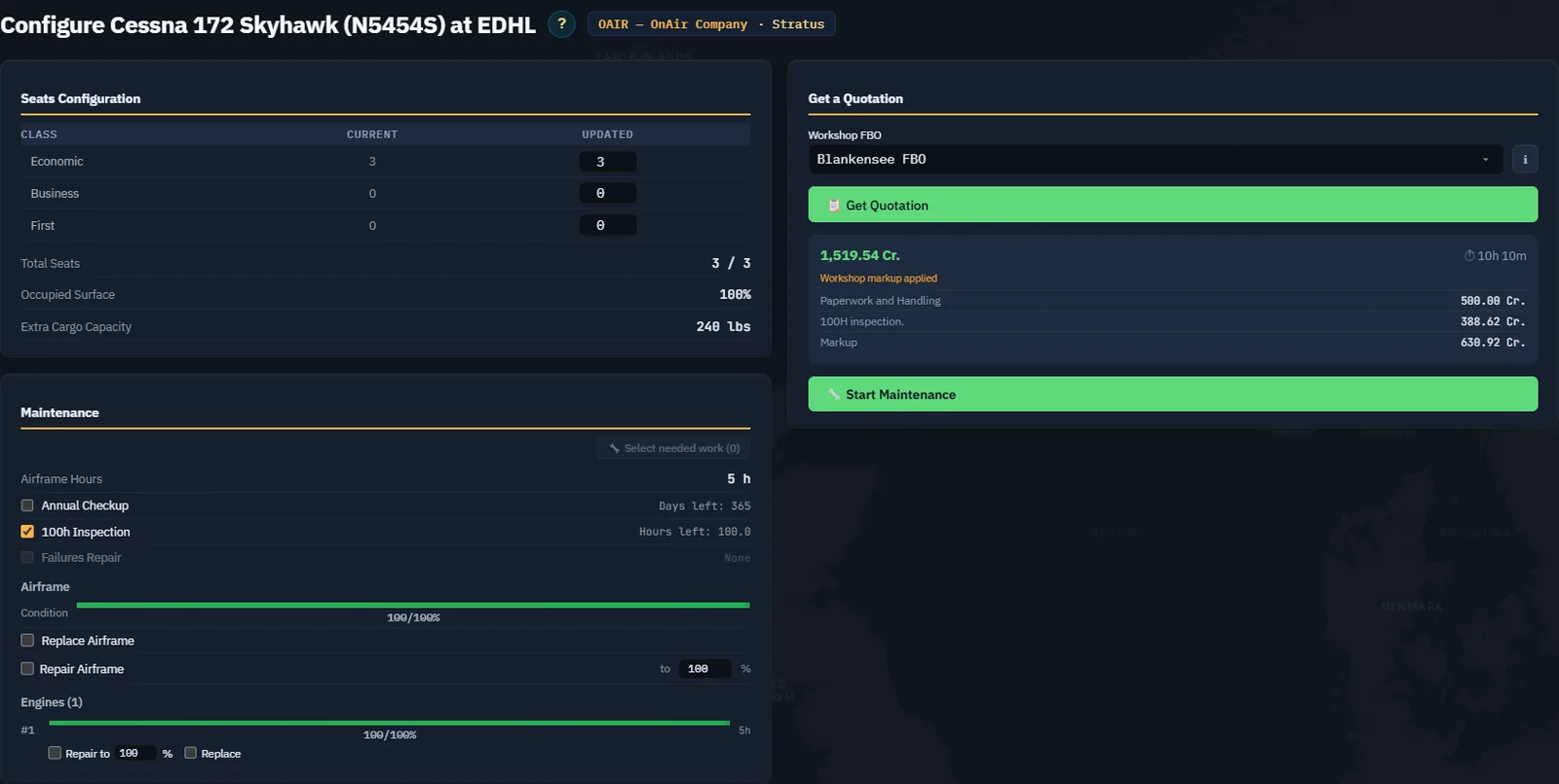
Review the selected FBO, total, individual operations and time before Start Maintenance. Recalculate the impact on accepted deadlines, work orders and regular routes. A small invoice can still cause a costly missed mission if the aircraft is unavailable at the wrong time.
Step 5. Confirm when maintenance is actually due
When your aircraft needs the selected work and the schedule allows it, use Start Maintenance. Return to Fleet and verify its maintenance status and expected availability. Record the expense in your operating review.
Screenshot placeholder MR05 — maintenance in progress and completion. Use an aircraft with a real maintenance need. Capture the accepted quotation, Fleet maintenance status and ETA, then the aircraft after completion with updated inspection/condition values. Record the elapsed interval; do not use the quote as evidence that the work occurred.
Step 6. Treat cabin changes as operational changes
The same screen controls economic, business and first seats. Read Total Seats, Occupied Surface and Extra Cargo Capacity together. Larger seats use more cabin space; the number of available seats alone is not enough. Configuration also does not remove maximum weight limits.
Keep the tutorial Cessna's three economic seats unchanged for the accepted passenger mission. If adapting another aircraft, quote the change before committing, then reopen dispatch and recheck the mission's passenger classes, cargo and total weight against the completed configuration.
Step 7. Build a small readiness habit
Before each new assignment, check location and status, inspection allowance, failures, crew availability, fuel and payload. Before expanding the fleet, identify where each aircraft class can be serviced. Owning an FBO without the appropriate workshop agreement does not solve that coverage gap.
The next chapter combines maintenance, wages, fuel and acquisition costs into a cash review before expansion.